
Have SC Midlands ever had snow on Christmas? Here’s the historic data and this year’s forecast
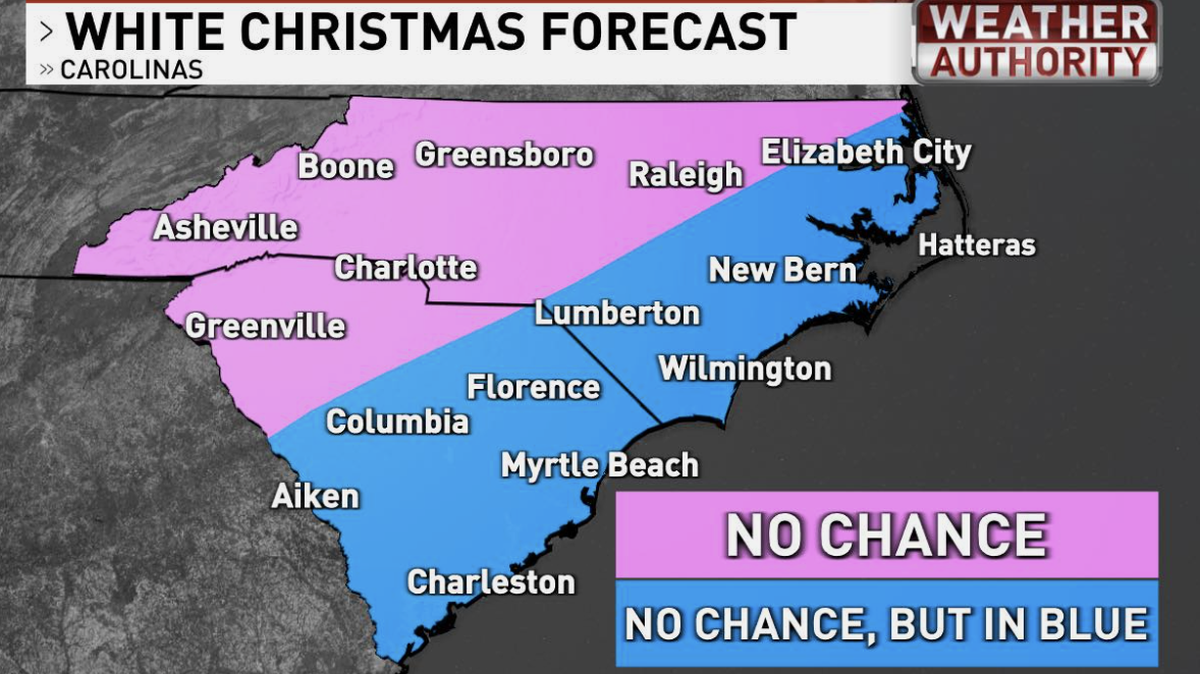
Ed Piotrowski, the chief meteorologistmet at WPDE in Myrtle Beach, released his forecast for South Carolina Christmas snow with a map on Facebook.
It shows the northwestern part of the state in pink and the southeastern in blue. The line runs roughly through Columbia.
Pink means no chance of snow. Blue means no chance but in blue.
It’s been 36 years since any snow fell on Christmas in South Carolina and that coastal storm didn’t extend to the Midlands.
You’ve got to go back to 1935 for there to be any sort-of measurable snow on the ground at Christmas. That was from a storm a few days before Christmas and the snow had not yet melted.
State climate records, which began in 1887, say it has not snowed in Columbia on Christmas Day since 1924 and that was categorized as a trace. It had rained almost 3 inches on Christmas Eve so that probably nixed any idea of trace snowmen.
Columbia meteorologist Jim Gandy wrote in 2011 that South Carolina is more likely to get a wet Christmas than a white one.
“It is like a cruel joke from Mother Nature,” he said.
History tells us the most likely time for snow in South Carolina is February. It snowed last year in Columbia in January.
The 2026 Old Farmer’s Almanac Christmas Forecast concurs with Piotrowski, the National Weather Service and anyone who predicts weather.
Still a bit early to say for sure what the weather will be but the chance of snow in South Carolina on Christmas is low. In fact, temperatures may be in the 60s and 70s.
“Milder, gentler winter than average,” the Old Farmer’s Almanac says.
That’s the La Nina effect — cold and snowy in the northern U.S. warmer in the south.
The National Oceanic and Atmospheric Administration says if you want a white Christmas you’ve got to go elsewhere.
“Alaska. Minnesota. Maine. Upstate New York. The Allegheny Mountains of Pennsylvania and West Virginia. Practically anywhere in Idaho. And of course, the Rockies or the Sierra Nevada Mountains,” the agency said.
The most significant weather event the State Climate Office recorded in recent years was heavy snow along the coast in 1989 from Dec. 22-24, 1989. Myrtle Beach had 14 inches, Charleston 8, Beaufort 5.
“Life along the Carolina coast ground to a halt as extraordinary amounts of snow overwhelmed the modest amount of snow removal equipment,” the National Weather Service said on its website.
This was the same year Hurricane Hugo devastated the South Carolina Lowcountry, coming onshore in September as a Category 4 storm just north of Charleston.
Other winter storm events on Christmas Day reported by the climate office include:
1899 — Snow mixed with sleet in a few western South Carolina areas, but it melted as it fell.
1945 — A significant ice storm — mixture of rain, snow, sleet and freezing rain fell on 24th through early morning 25th (8.5” Caesars Head, 5.2” Spartanburg, 2” Greenwood).
1947 — A trace to 6 inches at Caesars Head and Long Creek fell in the Upstate.
1953 — Wet, cold and blustery winter conditions with a few snow flurries in the northern part of the State.
1975 — Freezing rain in the Upstate.
1998 — A trace reported in the Upstate.
2004 — Late evening mix of rain, sleet, freezing rain and snow over central and coastal South Carolina, leaving behind a light coat of ice, causing travel troubles and power outages.
Then there’s the truly bizarre, known as June in December, when temperatures rose into the 70s in 1984 across the state. It was caused by the jet stream bringing winds from the southwest rather than the usual northwest. It stayed that way for two weeks.