In a first for South Carolina, Brad Sigmon is executed by firing squad
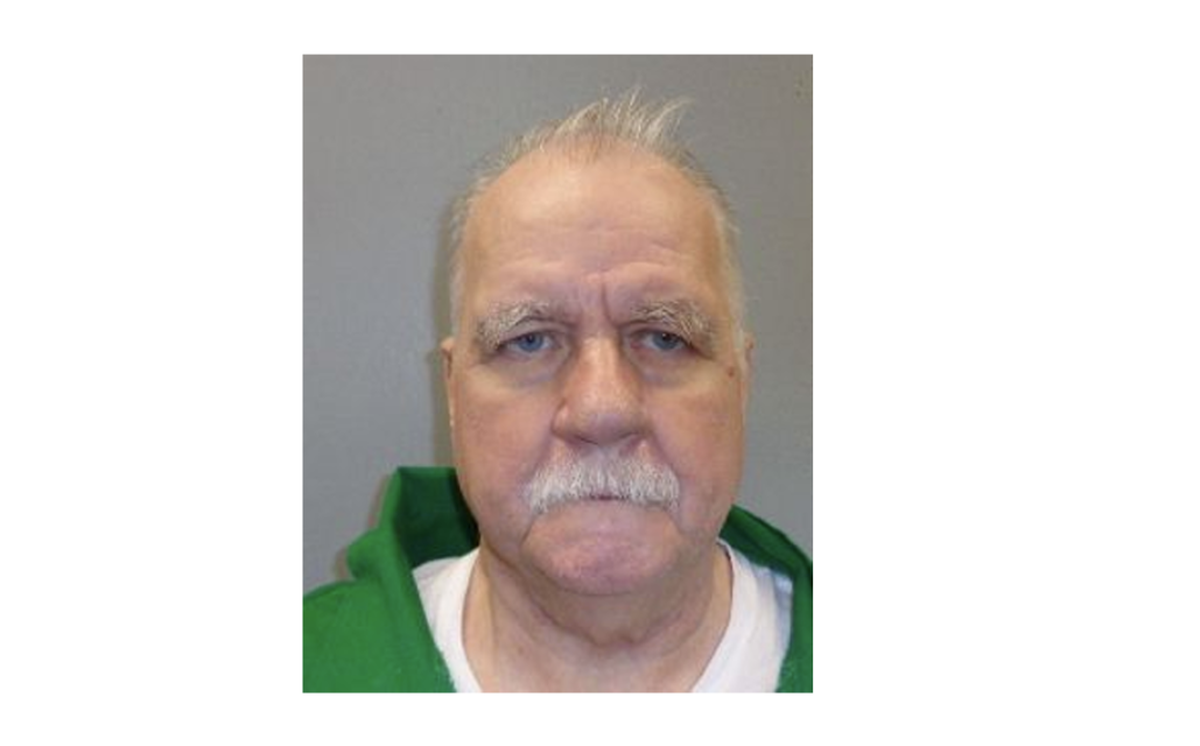
Just after 6:05 p.m. inside of the Broad River Correctional Institution in Columbia, the silence of the state’s death chamber was broken by the crack of three unseen rifles and blood spurted from the chest of Brad Sigmon.
He is the first person in South Carolina to have been executed by firing squad and only the fourth in the entire country to have been executed by firing squad since the U.S. Supreme Court allowed executions to resume in 1976.
At 67 years, Sigmon is the oldest person ever executed in the state of South Carolina.
His death by firing squad comes 23 years after he was convicted in the brutal murders of David and Gladys Larke and more than a decade into a battle over the method used to carry out the death penalty in South Carolina. A survivor of an abusive and unsettled childhood, Sigmon’s attorneys said that he beat the Larkes to death with a baseball bat following a night of drinking and crack cocaine use while under the delusional belief that he could reunite with his ex-girlfriend, the Larkes’ daughter.
Media witnesses to the execution — Jeffery Collins from the Associated Press, Tiffany Tan from The Post and Courier and Anna Dobbis with WYFF News 4 — reported that just after 6 p.m., the death chamber’s curtain was pulled back to reveal Sigmon strapped down in a metal chair.
Straps ran across his chest, his legs were shackled and his arms were pinned by his side. His jaw was held in place with a sling but through the bulletproof glass separating the witnesses from the death chamber he appeared to mouth to his attorney, Gerald “Bo” King, that he was “OK.”
For his last meal, Sigmon requested four pieces of fried chicken, green beans, mashed potatoes, bisuits and gravy, cheesecake and sweet tea.
Instead of the typical green jumpsuit worn by inmates at the Department of Corrections, Sigmon was dressed in a black jumpsuit and black plastic shoes. A white rectangular target with a red bullseye was pinned to his chest.
King, the chief of the capital habeas unit at the Fourth Circuit Federal Public Defenders Office read Sigmon’s final statement to the witnesses, which also included three members of the Larke family, a representative of the Greenville Solicitors Office, the Greenville Sheriff’s Office and Chrysti Shain, director of communications at the South Carolina Department of Corrections.
In it, Sigmon, described by supporters as a prodigious and gifted reader of the bible, cited numerous verses and called “to my fellow Christians to help us end the death penalty.”
“An eye for an eye was used as justification to the jury for seeking the death penalty,” Sigmon said. “We no longer live under the Old Testament law but now live under the New Testament.”
A hood was then placed over Sigmon’s head, and an employee of the corrections department lifted a covering on a brick wall 15 feet away from where Sigmon was strapped to the chair, revealing three, horizontal gun ports.
Just after 6:05 p.m., the witnesses described a “very loud” crack of rifle fire. A small amount of blood shot from his chest as his arms appeared to flex. His chest moved twice and an irregular oval of blood the size of a fist spread from his wound.
A basin around the base of metal chair appeared to catch several drops of blood, Tan said, while the target appeared to be gone.
A medical professional then entered the chamber and inspected Sigmon for approximately 90 seconds. While the Department of Corrections does not disclose what kind of rifle they use, the three members of the firing squad are all given live ammunition. The .308 Winchester TAP URBAN rounds are designed to fragment on impact, causing catastrophic damage to internal organs.
He was declared dead at 6:08 p.m., while outside the Broad River Road prison supporters prayed and a bell tolled.
“For sin shall not have dominion over you,” Sigmon said in his final statement, citing Romans 6:14. “For you are no longer under the law but grace.”
The road to the firing squad
The South Carolina General Assembly voted to add firing squad as an option for the death penalty in 2021, the same year it reinstated the electric chair as an option. It came as part of a push to restart executions after they were paused in 2013 when the state ran out of the drugs needed to perform lethal injections following international pressure on drug manufacturers.
Former Senator Dick Harpootlian, D-Richland, said that he pushed to have the firing squad added as a more humane option compared to the electric chair. As a prosecutor, Harpootlian had infamous South Carolina serial killer Donald “Pee Wee” Gaskins sent to the electric chair for murdering another inmate with a bomb hidden inside of a radio.
“I thought then and I believe now that it [the electric chair] is a horrendous, barbaric way to kill somebody,” Harpootlian said.
Sigmon is the first person to opt to die by firing squad — death row inmates in South Carolina must choose their method of execution from lethal injection, electric chair or firing squad. He made his choice amid growing concerns about the state’s lethal injection protocol, which consists of a massive dose of the drug pentobarbital, a powerful sedative that causes death by asphyxiation.
In January, the U.S. Justice Department under former Attorney General Merrick Garland announced that it was suspending the use of the pentobarbital protocol citing concerns that it caused a cruel and unusual death. Current Attorney General Pam Bondi has said that the method is under review.
Following recent executions, lawyers for death row inmates have increasingly raised concerns that the sedative used in the state’s executions causes an unnecessarily painful death. The autopsy of Richard Moore found fluid in his lungs, evidence of a pulmonary edema, which experts say could have caused the excruciating feeling of drowning as he was dying.
Just hours before his execution, the United States Supreme Court declined to take up Sigmon’s case, quashing his final appeal. His legal team had asked the nation’s highest court to stay the execution as he had not been given enough information to make a selection about his method of execution.
The choice Sigmon faced was “impossible,” said one of his attorneys, Gerald “Bo” King, Chief of the Capital Habeas Unit for the Fourth Circuit Federal Defenders in a statement. “Unless he elected lethal injection or the firing squad, he would die in South Carolina’s ancient electric chair, which would burn and cook him alive.”
After 24 years on death row, Sigmon’s supporters had said that he was a very different man from the one who beat the Larkes to death with a baseball bat in 2001 during a home invasion. He was under the delusional belief that he could rekindle a relationship with their daughter, his ex-girlfriend, following a night of drinking and crack cocaine use.
After forcing his way into the Larke’s home in Greenville, Sigmon moved from room to room, repeatedly beating Gladys and David with the bat to make sure that they were dead. He then abducted his ex-girlfriend, forcing her into a car. When she fled the vehicle, he shot at her, missing.
At sentencing, Sigmon gave a bizarre and rambling statement in his own defense, which his defense team said was the result of undiagnosed and untreated bipolar disorder. This was just one of the elements of Sigmon’s tragic background that his attorneys say was not properly presented to the jury.
Sigmon grew up in an unstable and violent home — while his mother was regularly absent, his father was an alcoholic who physically abused Sigmon’s mother and four younger siblings. From a young age, Sigmon, the eldest child, was regularly hit and punched while attempting to stand up to his father.
When his mother left, the situation only grew worse, according to court filings. He was abused by his stepmother and made homeless as a teenager.
Mental illness is “rampant and severe” in Sigmon’s family and among his siblings, according to his attorneys. Many have been diagnosed with bipolar disorder, schizophrenia, depression and suicidality, according to court filings.
During his time in prison, Sigmon became a devout Christian and mentor to others on death row.
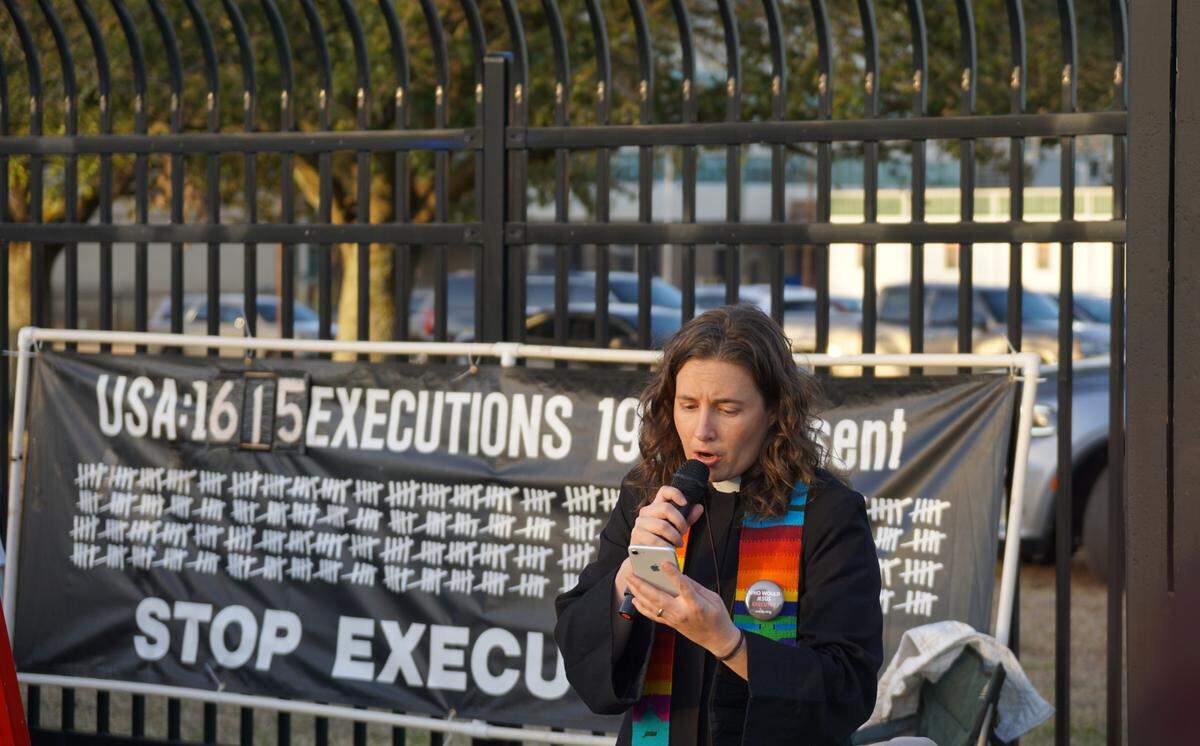
“So often the people who commit violence are themselves first victims of violence,” said Hilary Taylor, a Methodist pastor and Sigmon’s spiritual advisor. She wishes people could have heard “the depth of his remorse” and his desire to “be a solution to violence.”
Protesters cite scripture in opposition to execution
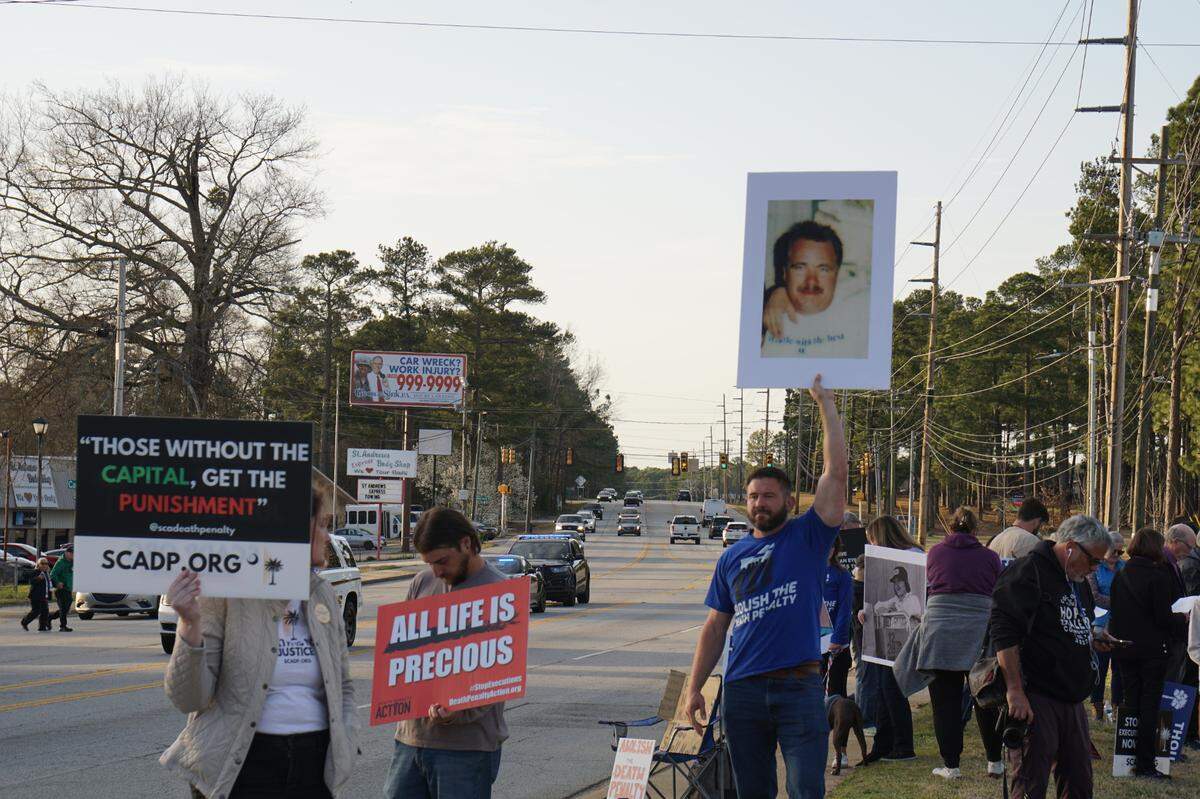
From Charleston to Greenville, nearly 30 people gathered outside the gates at the Broad River Correctional Institution in protest of Sigmon’s execution.
Ranging in age from 21 to 62, they said state executions are wrong because God is the ultimate arbiter in the death of a human being.
Rev. Larry Jesion, 62, of the Episcopal Church from the Diocese of Georgia, and his wife, Pam Jesion, said a friend, who served as Sigmon’s chaplain in prison right up till his execution, led them to Columbia in protest of Sigmon’s death.
“If we profess to believe in the Holy Scriptures, then it’s up to God to judge,” Jesion said. “I’m not saying it doesn’t excuse somebody from breaking the laws of man, but to ultimately carry out death is God’s right to do.”
“It’s legalized lynching,” his wife added.
Another protester from the Charleston area said he opposes the death penalty because “thou shall not kill.”
“It’s not our place to be taking other people’s lives,” Jason Jones, 27, said.
Although Sigmon’s choice of execution by firing squad was the first in South Carolina’s history, protesters, like Jones, said, “The manner of death is irrelevant.”
“He got all three choices, and for whatever reason, he chose that one, and that’s his decision,” Jones said.
Like the Jesions, Rev. Dr. Regina Moore of the South Carolina Christian Action Council in Columbia, said she stands in protest of Sigmon’s death as a “Christian witness.”
“The scripture reminds us that we should not kill and that vengeance is the Lord’s,” Moore said. “It deeply saddens me that this state has chosen to kill a senior citizen, and whether his choice [of death was] by firing squad or not, at the end of the day, he is being killed on my behalf and on your behalf.”
Grant Bell, 21, of Greenville is no stranger to death penalty protests. He said he has protested every recent execution in South Carolina since Freddie Owens except one.
In light of the amount of time it took the state to carry out Sigmon’s execution, Bell classified Signmon’s death as “murder.”
“We are to respect and obey our government if our government is good,” Bell said.
Shortly after it was announced that Sigmon was dead, protesters silently lined the fence of the Broad River Correctional Institution on Broad River Road, holding a variety of signs, including, “No more killing!,” “All life is precious,” and “Eye for an eye makes the whole world blind.”
Updated after Brad Sigmon’s execution.
This story was originally published March 7, 2025 at 4:04 PM.