SC wants to change how it taxes your income. Here’s what we know about the proposal
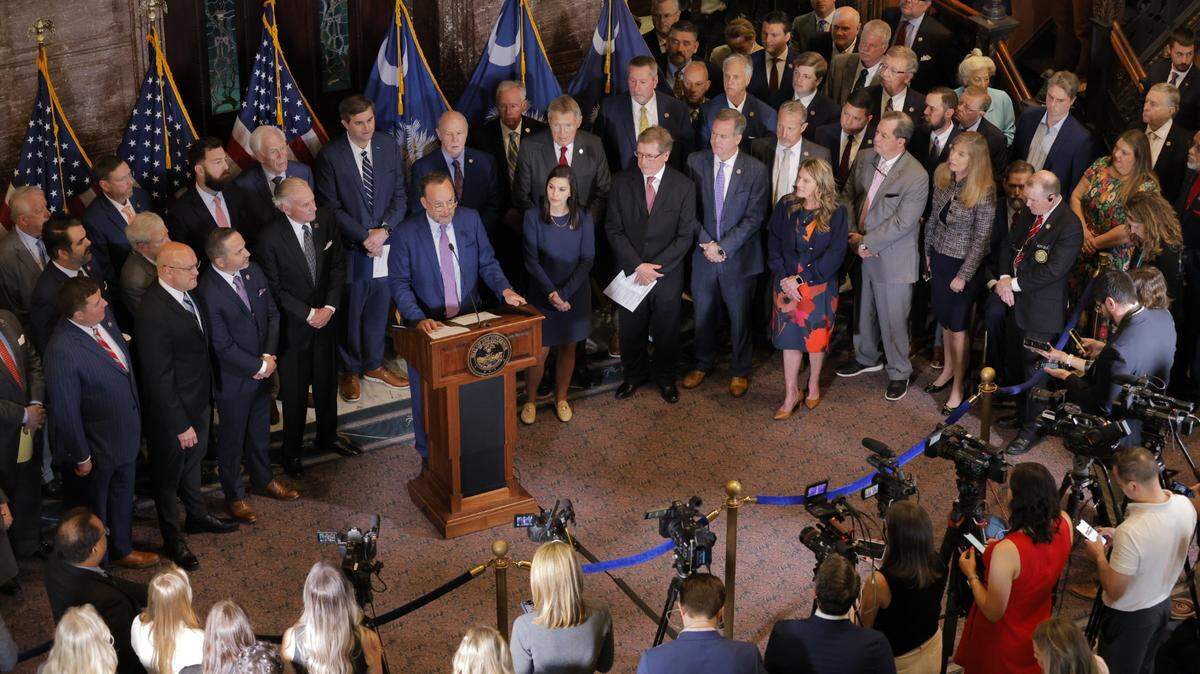
South Carolina income tax filers would see a new flat tax under a proposal unveiled by House and Senate leadership.
Under the plan, people would keep more money in their paychecks, but see a smaller refund when they file their taxes in 2027.
The tax cut proposal rolled out Tuesday by House Speaker Murrell Smith, House Ways and Means Chairman Bruce Bannister, Senate President Thomas Alexander, Senate Finance Committee Chairman Harvey Peeler and Gov. Henry McMaster would bring the state’s income tax rate to 3.99% in 2026 under a new flat tax system away from the state’s current two-tier income tax, where the highest rate is 6.2%.
If income tax revenue grows by enough each year, the income tax rate would drop as well, until it reaches 2.49%.
However, under the plan, the tax rate for future years won’t be known until income tax revenue levels are determined. The goal would be to keep about $200 million out of state coffers every year until the state reaches 2.49%.
The key part of the plan is shifting to adjusted gross income away from federal taxable income.
The switch to adjusted gross income allows the state to compare apples to apples when comparing tax rates with neighboring states.
South Carolina’s current 6.2% rate is higher than Georgia’s current rate of 5.39% and North Carolina’s 4.5%. Georgia also is working to cut its rate to 4.99% by 2028.
When taxpayers in Georgia and North Carolina file their annual returns, however, they start with adjusted gross income. When tax filers in South Carolina fill out their state 1040 form, they will start with the lower federal taxable income — the amount on a person’s IRS 1040 form after subtracting deductions.
Under the current system, starting at the federal taxable income and because of the deductions and credits available, 44% of filers don’t pay any state income tax, and 10% of filers account for 63% of income tax liability in South Carolina, which creates a narrow base.
Shifting to adjusted gross income and going to a flat tax is strategic.
“That makes us not only more competitive, but also more attractive to new businesses and more affordable for families to call South Carolina home,” Bannister said.
The proposed bill also would maintain all the existing deductions and credits.
Going to adjusted gross income will lead to some people paying more, but Bannister said setting up a 3.99% is a fair tax rate.
“There are people in the million dollar tax bracket who will get a break, and there are people in the million dollar tax bracket who will pay more, just don’t pay anything now, so there’s no average number,” Bannister said. “What we do know is that when we change the tables withholding tables, every South Carolinian who gets a paycheck will have more money in their paycheck than they did before this change.”
Making the switch for 2026 allows the Department of Revenue to send out new withholding tables to employers and allow filers to make any necessary adjustments.
The goal of the tax reform is to spread out the tax burden in the state and broaden the tax base.
To help soften the blow for people who may end up receiving smaller refunds than they’re used to, the state also would create a $6,000 personal exemption for certain filers. Those who have an adjusted gross income of $30,000 or less, would be eligible for the exemption. That exemption will phase for filers who earn between $30,000 and $40,000.
Also attending and speaking at the news conference was Americans for Tax Reform President Grover Norquist, who is known for having elected officials sign a pledge opposing any tax increase.
If the plan is approved by the House, it will move to the Senate, where Peeler has said he often says no one out-tax cuts him. He joked about making the plan “better” in the Senate.
“I’m so proud of us to continue working together both House and Senate, Finance and Ways and Means to make this happen, and not just end this today on income tax, but also address sales tax and property tax, we need to lower both too. There’s nothing this team can’t do working together.”
State Sen. Darrell Jackson, D-Richland, and a Senate Finance Committee member, commended the GOP budget writers for trying to cut the income tax rate, but said he doesn’t think the plan goes far enough.
Jackson said he will propose eliminating all income tax in the state if and when the plan comes to the Senate for debate. It’s a similar call made by hard-line conservative House Freedom Caucus members and state Rep. Justin Bamberg, D-Bamberg.
“I think if we’re going to look at tax reform we should go all the way and totally eliminate state income tax,” Jackson said.
“I think we should work together to do it, and I don’t think we should do anything that is a bandage on it. I think the goal ought to be to totally eliminate income taxes and let’s do it right away,” Jackson added.
This story was originally published March 25, 2025 at 1:03 PM.