
I’m the rabbi censored for remarks on Holocaust Remembrance Day. Here’s why I said what I said. | Opinion
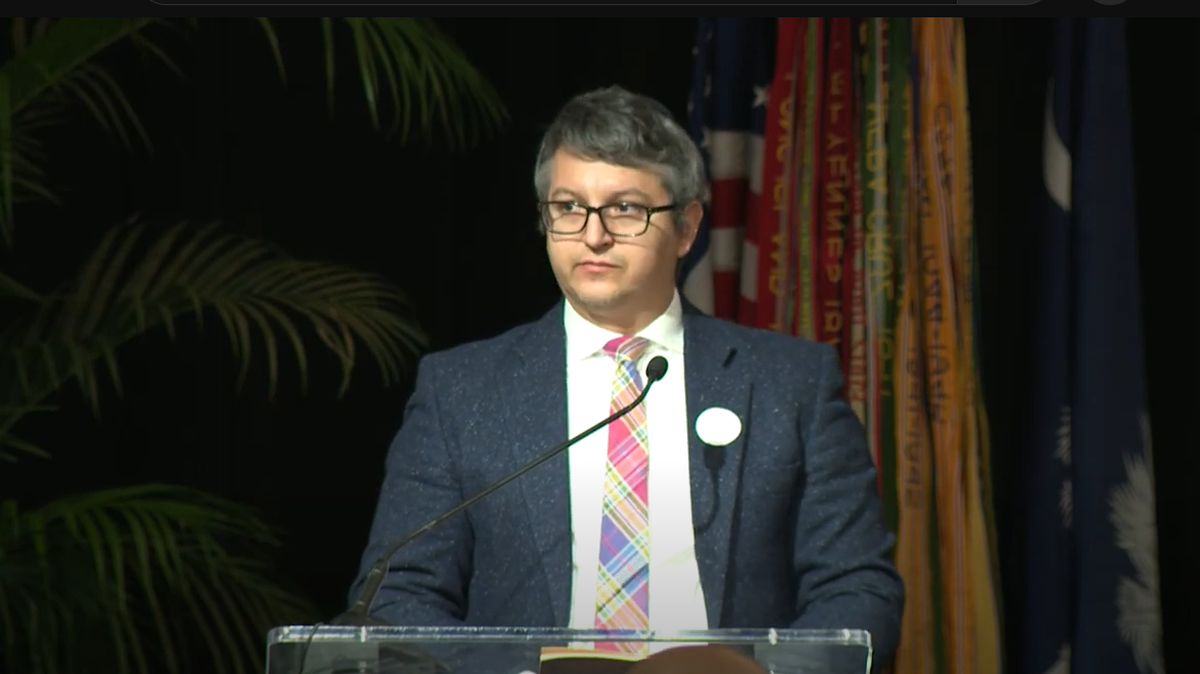
We are a month removed from the South Carolina Council on the Holocaust’s 80th commemoration of the liberation of Auschwitz on Jan. 27. I was invited that day to say Kaddish — a prayer recited to honor the memories of the dead — on behalf of those murdered during the Holocaust, and to offer a benediction to conclude the program.
I struggled to find the right words then, as I struggle to write these now.
Holocaust memorials for the Jewish community are sacred events. They are deeply personal: Most Jews living in the United States are in some way directly linked to the atrocities of the Holocaust. I personally grew up living in a house with a Holocaust survivor. My grandmother’s partner, my non-biological “Grandpa Henry,” born Yechiel Moskowitz, was a survivor.
With immense anguish, he began telling me of his immeasurable trials in the Lodz and Kielce ghettos when I was 11 years old and I interviewed him for a school project. He shared his stories of the brutal and inhuman conditions and torture he experienced at a series of concentration camps including Sachsenhausen. Most of his immediate family were murdered at Auschwitz. When I was 18 years old, several years after my grandmother had passed away, he explained to me that he wasn’t ever able to marry my grandmother because of the mental scars he carried from when the Nazis murdered his fiancée right in front of him.
He passed away 12 years ago, but I still think about him often and wonder If I could have had his strength. Grandpa Henry is one of the people in my life who taught me to never be a quiet Jew. He taught me to be a fighter, to stand up to antisemitism and hatred of all kinds, and though I did not mention him by name in my benediction last month, I said what I said in part to honor his memory.
Before I shared my prepared remarks, I sat and respectfully listened while Gov. Henry McMaster and state Superintendent of Education Ellen Weaver said they were “standing against … evil” and “being upstanders for the vulnerable and champions of the good.”
Yet as I was thinking when I wrote my remarks, South Carolina bans the teaching of AP African American Studies in public schools and bans books that represent different points of view. And South Carolina leaders support current presidential executive actions and orders, including those which target members of the LGBTQ+ community, and which call for the full shutdown of the federal refugee admissions program and the U.S. Immigration and Customs Enforcement raids that have targeted citizens and non-citizens alike.
It is critically important for me to note that the atrocities of the Holocaust did not occur in a vacuum. I feel that it is essential for the Jewish community to embrace the idea that while antisemitism is on the rise, that it does the Jewish community no good to exist solely in an echo chamber of our own suffering. In fact, there is an ancient rabbinic text called Midrash Tanchuma (Mishpatim 2:1) that discusses Proverbs 29:4 which says, “By justice, a king sustains the world. But a person who sets himself apart utterly destroys the world.”
The Tanchuma elaborates. “If a person sets himself aside, by secluding himself in the corner of his home and says to himself, ‘What concern are the problems of the community to me? Why should I be concerned about Justice for them? Why should I listen to them? My soul will be at peace.’ Behold, this way of being destroys the whole world.”
In that moment I was given on Jan. 27, I chose to name only a few of the policies that are a dangerous echo of what took place in prewar Nazi Germany. I knew there would be pushback. People in positions of power don’t like to be challenged. I did not, however, expect to be censored with my remarks cut from the event’s official video.
In an interview with The Jewish Telegraphic Agency, Dr. Lilly Filler, the chair of the council’s executive committee, called what I did a “political attack” which I should not have done because our state officials “have been wonderful to us.”
But I could not abide if teaching about the Holocaust is contingent on remaining silent in the face of the enactment of and support for discriminatory policies targeting other vulnerable minorities, and the censoring of education about other people’s sufferings.
There was no way that I was going to quietly end the program.