
Why the hosts were right to cut a South Carolina rabbi’s remarks on Holocaust Remembrance Day | Opinion
Remembering the Holocaust is a solemn duty. We reflect on and honor the victims, the survivors, the rescuers and those who acted righteously during this atrocious period in history.
International Holocaust Remembrance Day on Jan. 27 recognizes the systematic extermination of 6 million Jews as well as Soviet prisoners of war, ethnic Poles, Roma, people with disabilities, and others who were persecuted by the Nazi regime.
This year was the 80th commemoration of the liberation of Auschwitz, a concentration and extermination camp in Poland liberated by the Soviet Red Army, and the site of unspeakable horrors, where more than 1.1 million people were murdered as part of the Nazi’s “final solution.”
When the camp was liberated, approximately 7,000 survivors remained, in unspeakable physical condition, at serious continued risk of starvation despite the end of their torture.
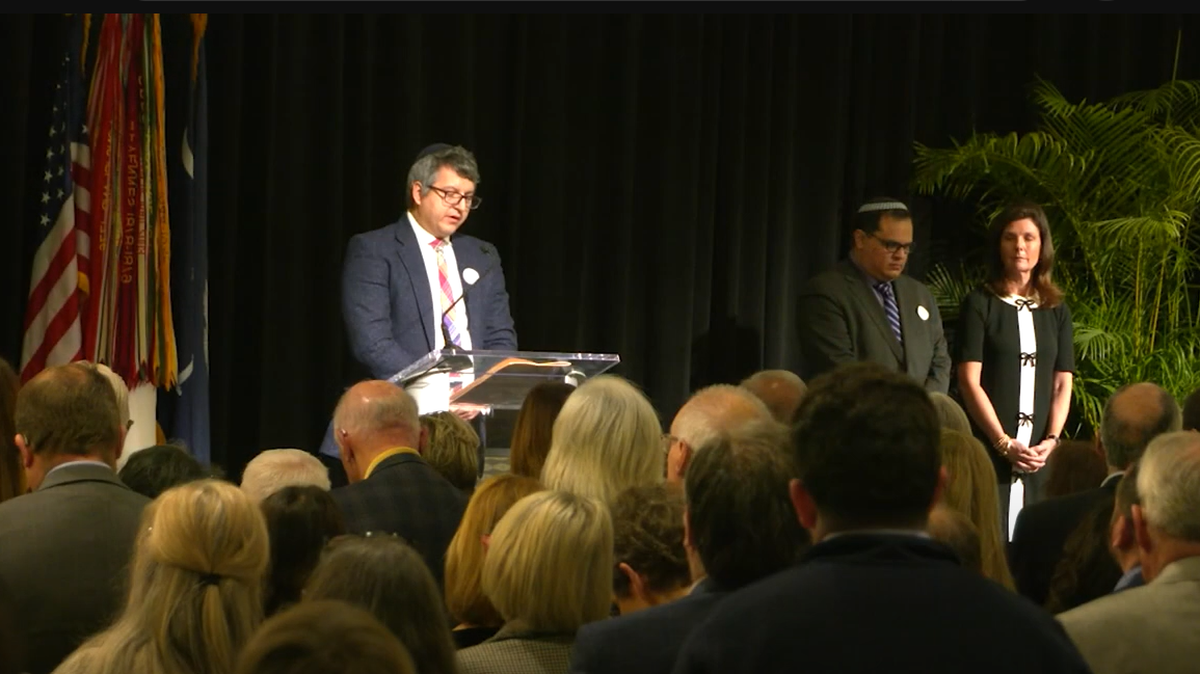
The South Carolina Council on the Holocaust hosted an 80th commemoration of the liberation of Auschwitz in Columbia last month on the day of remembrance.
At the event, a benediction was given that veered far from the event’s purpose. Temple of Israel Rabbi Samuel Rose turned the moment into a partisan critique of elected officials and the current administration, drawing contemporary analogies that cheapened the gravity of the occasion. The misuse of Holocaust remembrance is not only inappropriate but dangerous.
By injecting modern grievances into an event meant for unity and historical reflection of humanity, we risk distorting history, alienating allies, and diluting the lessons we must carry forward.
The Holocaust was a state-sponsored, industrialized genocide aimed at the systematic extermination of an entire people and dissidents. Attempts like Rabbi Rose’s to discuss it in the broader context of contemporary political debates on federal immigration policy, LGBTQ+ rights, or book bans are not only historically inaccurate but profoundly irresponsible. The analogies trivialize the suffering of victims and survivors, reducing their life experiences to talking points in today’s policy discourse.
While it is vital to confront injustice wherever it exists, moments dedicated to Holocaust remembrance are not platforms for political point-scoring. This critique is not personal. In another setting, I would welcome and support thoughtful dialogue on these topics.
Holocaust survivors, their families and their rescuers — righteous among the nations, a title given to non-Jewish people who risked their lives to save Jewish people, have shared their stories and fought for decades to ensure that the world never forgets. These stories remind us that the Holocaust is not a metaphor. It was their reality.
Last month, the Anti-Defamation League released a survey that showed nearly half of the world’s adult population — 46% — hold “deeply entrenched” antisemitic attitudes. That is more than double what ADL’s first worldwide survey found a decade ago, and it is the highest level ADL has reported.
It equates to an estimated 2.2 billion people harboring anti-Jewish bias around the world.
Even more alarming, 20% of survey respondents worldwide said they had never even heard of the Holocaust, and less than half — just 48% — said they believed in its historical accuracy. That number fell even further among adults aged 18-34. Only 39% of these younger adults acknowledged the Holocaust as a historical fact.
This is a crisis of historical memory, and it underscores why Holocaust remembrance must remain undiluted and untainted by partisan rhetoric. The South Carolina Council on the Holocaust was founded with the purpose of developing educational programs that honor Holocaust survivors, their descendants and South Carolinians involved in the liberation of concentration camps, while fostering awareness to prevent future atrocities.
The council exists to educate not to be co-opted for ideological grandstanding or self-congratulatory moral posturing. The council’s Dr. Lilly Filler acted appropriately in cutting Rabbi Rose’s remarks from video of the event, as they failed to reflect the council’s mission or uphold the high standards of Holocaust education: prioritizing historical accuracy, unbiased analysis and an apolitical approach to preserve the integrity of teaching this critical history.
Holocaust remembrance must remain sacred. It must be protected from opportunistic rhetoric, contemporary political distortions and analogies that dilute the historical truth. If we truly wish to learn from history, we must let the memory of the Holocaust speak for itself — without distortion, without partisanship and without political theater.