
Only one way for SC Holocaust Council to undo damage of censoring a rabbi’s plea | Opinion
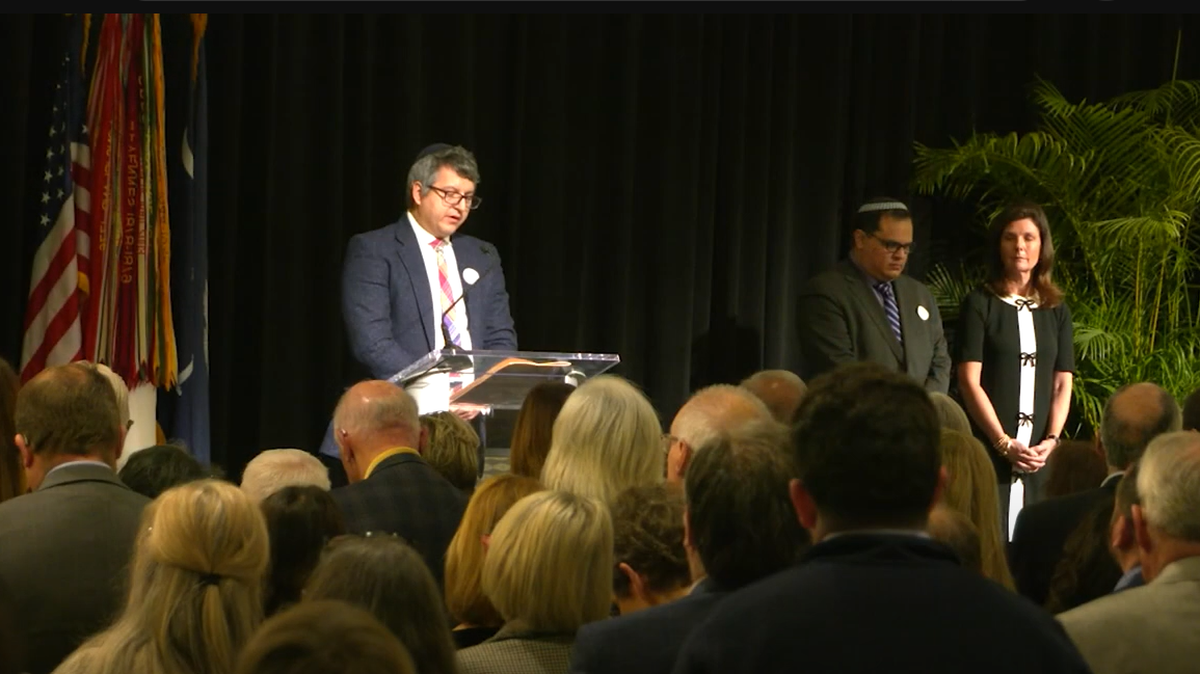
Imagine gathering more than 500 people to reflect on the horrors of the Holocaust and its permanent silencing of 6 million Jews — and then purposely erasing a rabbi’s words from the historic record of the event.
It would be unthinkable unless you live in South Carolina where this not only happened on Jan. 27 to Rabbi Samuel Rose but was done to him by the South Carolina Council on the Holocaust and defended by its executive committee chair, whose parents survived the Holocaust. She found his call for tolerance so unacceptable she cut it from a published video of the 90-minute event.
You know who liked his message? Most of the audience, which gave him a thunderous, at least 26-second standing ovation. His video of the remarks cuts off with applause still raining down.
In the audience, Gov. Henry McMaster and state Superintendent of Education Ellen Weaver did not stand.
Talking to local reporters after the event, McMaster said that he and Lt. Gov. Pamela Evette “understand that people have the right to speak their mind and opinion but we respectfully disagree very much” with Rose’s points that criticized recent Trump administration actions on immigration and gender, which McMaster called “the proper actions.”
Let’s state that again: We understand that people have the right to speak their mind and opinion.
You can read all of the rabbi’s stricken remarks at the end of this column.
Here’s a portion, transcribed from a 6-minute video the rabbi posted on YouTube: “As Jews, our calling is not to erase difference, but to celebrate it, to protect it, to honor the image of God in all people, in the diversity of human experience, of humanity. Holy one of blessing, give us that strength to be upstanders in the face of injustice.
“When refugees are being turned away, may we open our doors. When members of the LGBTQ community, when individuals, are targeted, may we shield them with love. When immigrants are cast aside, may we embrace them as the Torah commands us to do 37 times, to love the stranger in your midst as you love yourself.
“And if antisemitism and bigotry arise, may we confront them boldly, armed with truth and righteousness.”
Cutting that from the record was the opposite of bold: cowardly in any context but especially the context of the International Holocaust Remembrance Day the event was designed to honor.
Donors worldwide gave half a million dollars to help preserve 8,000 discarded, disintegrating shoes of Jewish children killed in Auschwitz so that the unimaginable anguish of the Holocaust will never be forgotten or repeated. Yet a group established in South Carolina in 1989 to “prevent future atrocities” just cut six minutes of a rabbi’s remarks from the video record of an event held on and to commemorate the 80th anniversary of the liberation of Auschwitz.
As if the words never happened. As if they didn’t matter. As if the point didn’t need to be made 80 years ago, today and forevermore.
Leah Chase, a former member of the council, told The State’s Ted Clifford that she was “embarrassed and ashamed” by the decision to cut the rabbi’s remarks from the record. At least one council member, Furman University professor Melinda Menzer, who attends Rose’s synagogue in Greenville and is also a descendant of Holocaust survivors, has resigned.
Others should at least threaten to quit, or leave themselves, unless or until Dr. Lilly Filler, the executive committee chair, agrees to step down herself or restores the rabbi’s remarks in the permanent record.
Filler told Clifford the rabbi’s talk of “current day politics” was “an embarrassment to me, as the chair.”
Filler has to reconsider. That’s how unacceptable this most upsetting and ironic of offenses truly is.
Normally, I’d interview a person before calling for them to exit something involuntarily, ask why they did what they did, hear them out and reflect on their words. It’s what I did before calling on state Treasurer Curtis Loftis to resign recently. But part of the point of this column is to get Filler to understand what it feels like to have your words excluded for being deemed unworthy of the historic record.
I purposely chose not to call her just as she purposely chose to silence Rabbi Rose. But that’s no way to represent a community, whether it be a community of journalists or of Jewish people. Tolerance is the mission, especially at a Holocaust memorial.
I hope that point isn’t lost on her as the ramifications of her actions clearly were when she inexplicably, hypocritically justified silencing a rabbi on the 80th anniversary of the liberation of Auschwitz. She should read or reread the remembrances of the survivors the South Carolina Council on the Holocaust collected and preserved for all time on its website as survivors increasingly die of old age.
Jadzia Stern ended her story with remarks for her kids, and theirs, and theirs, but really for us all.
“When there are no more Holocaust survivors to testify of the evil of the Jewish Holocaust — because in Auschwitz, the best of humanity were murdered by the Nazis — you will make me proud, dear children, if you will stand up to any form of defamation of Jewish people, and there’s one more thing. I know I’m asking a lot,” she said. “While you’re at it, speak also for other minorities because I believe in you, and we come from a decent and rich heritage, and we believe in justice and brotherhood for all people. And if you remember this, I will smile at you.”
If Dr. Filler restores Rabbi Rose’s comments to the event video so future generations can hear them and then apologizes to her critics, we should all smile, and she should be forgiven.
But the stain of her decision should trail her always, especially on each Holocaust Remembrance Day.
Never forget means doing just that.
The dignity of difference
Here is the full transcript of Rabbi Samuel Rose’s stricken remarks.
Eternal God, holy one of blessing, source of compassion and justice, we gather today in this sacred moment to honor and remember, to honor the memories of 6 million Jewish souls and the countless other lives stolen by the horrors of the Holocaust because of hatred and fear, and the inability of people to embrace the dignity of the difference.
We honor the survivors, carry and continue to carry the weight of that memory and graciously share that pain with us that they bore witness to so that we might learn and never forget. We honor the liberators, those individuals who bore witness to humanity’s darkest hour and restored hope to its victims. Their courage reminds us that even in the face of unimaginable turmoil, death, destruction and evil, that the light of righteousness can prevail.
Today, as we reflect on this sacred memory, we recognize that history’s lessons demand not only reflection, but action. In our time, we are witnessing a resurgence of hate and antisemitism, of prejudice, of discrimination. Our country which has served so often as a beacon of hope to those suffering around the world is now, as of this week, refusing aid of any kind to refugees.
If you didn’t know that, look up HIAS’ website. And I have to ask the question in front of this group, if the Holocaust happened and ended yesterday would the same Jews who were let in this country be let in today? Because the doors to all refugees were closed this week.
Members of my community, the Jewish community, have seen an incredible rise in antisemitism. My friends, my neighbors, my colleagues who are members of the LGBTQ+ community are terrified right now, not only because of the executive order also signed this week about gender and sex, but also because when you talk about education and the censoring of things where we need to learn about and legitimize the experience of suffering of other people, books are being taken out of libraries, and our children are not being taught the full spectrum of experience in this country.
These are just a few examples of the attacks on human rights and human lives which echo a dangerous refrain, one which we must not allow to grow louder. Rabbi Jonathan Sacks of blessed memory spoke often and wrote a book about the dignity of difference.
In it he asked the question, what is antisemitism? And with all due respect to all of the other definitions of antisemitism, I’m going to respect the one written by one of the most prominent rabbis of the last century, when he said, “Antisemitism is not only anti-Jewish hatred, but is more broadly viewed as the collection of the dislike of the unlike.”
Antisemitism, he argued, was the fear and hatred of people because they are different. Rabbi Sacks taught that God’s creation of human diversity was indeed a reflection of divine unity, and he argued that it was our imperative as Jews to continue to insist on being different, in order to ensure and to teach the world about the dignity of difference.
As Jews, our calling is not to erase difference, but to celebrate it, to protect it, to honor the image of God in all people, in the diversity of human experience, of humanity.
Holy one of blessing, give us that strength to be upstanders in the face of injustice. When refugees are being turned away, may we open our doors. When members of the LGBTQ community, when individuals, are targeted, may we shield them with love. When immigrants are cast aside, may we embrace them as the Torah commands us to do 37 times, to love the stranger in your midst as you love yourself. And if antisemitism and bigotry arise, may we confront them boldly, armed with truth and righteousness.
As we conclude this program, may the memory of those we honor today guide our steps. May we transform remembrance into resolve and may we work tirelessly to create a world where love triumphs over hate, where justice overcomes the fear that so many people have of difference and every person is able to truly find shalom, a sense of wholeness and the dignity of who they are.
Amen.