With owner dead, Cayce home sits vacant, decaying. The permit lawsuit persists
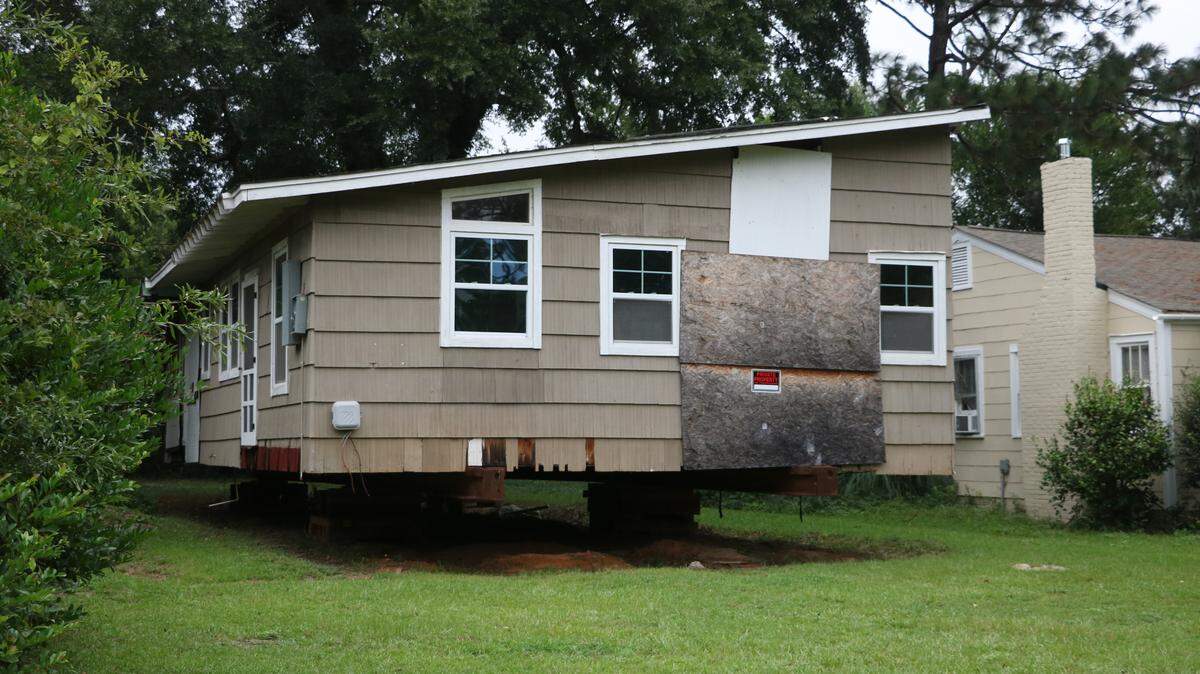
Nearly five years after the city of Cayce gave the greenlight for a longtime real estate broker to place a pre-constructed house on a small plot of land in one of the city’s most well-known neighborhoods, the home sits vacant and decaying, and the owner has died.
The home, a visible eyesore of the Avenues neighborhood, was set to be completed years ago, but a legal battle between the city and the property owner over a revoked permit has caused the home to sit derelict and abandoned, still raised on stilts above the yard and falling more into despair with the passage of time.
The lawsuit, brought by longtime real estate broker Richard Best, followed the revocation of Best’s permit to move the home to the property. After the city had already given the go-ahead, a group of neighbors rose up against the home and the city’s zoning board reversed the city staff’s decision to give Best a permit after he’d already spent $35,000 to move the home.
The lawsuit points to a larger trend of how Cayce’s government has approached growth and development in recent years. In an attempt to maintain the city’s small-town charm, leaders and residents have often turned their noses up at in-fill development. As Lexington, the county that Cayce sits in, has grown exponentially since the 1980s elected officials have grappled with how to mitigate growing pains associated with the influx of new residents and developments.
Frustrated neighbors
Best, a longtime South Carolinian and Lexington real estate broker, applied for a permit through the city of Cayce to put a 1,000 square-foot single family home on a vacant lot at 1028 M Ave. in the Avenues, a quaint, historic neighborhood not far from Cayce’s riverwalk and River Arts District.
In October 2020, the city granted him the permit, according to a lawsuit he filed less than a year later. By February, Best had spent around $35,000 to relocate the constructed home to the lot along M Avenue and had moved the home there.
Then came an appeal on the first day of March — Danny Creamer, a neighbor on the same street, didn’t think the house’s roof matched the character of the neighborhood and that the permit shouldn’t have been handed out, he told the city’s zoning board at an appeals hearing that April.
“As expected, the phone has started ringing regarding the house on M Ave,” a building official with the city wrote to Best in a February 2021 email asking when foundation work would be complete for the city to confirm the home met the infill development standards.
In one of the suit’s exhibits filed in June 2021, Best submitted a sketch plan of the exterior of the house and said, “It would look a lot prettier, but work was stopped by an appeal.”
A petition coaxing signers to “protect, support and have pride in the Avenues,” included in legal filings, was signed by 56 people. Sixteen neighbors showed up to the hearing to speak out against the property’s permit and the zoning board voted 4-1 to overturn the city’s initial decision.
What ensued is more than four years of back and forth between the city’s attorneys and Best after he filed a lawsuit in May 2021. Best died in the middle of the lawsuit and his wife, June, was added as the representative for his estate. And as the permit sits in limbo while attorneys fight over what’s fair and legal, the empty, deteriorating property serves as an eyesore in one of Cayce’s most sought-after neighborhoods.
“It’s a long, drawn out process that I hope no other community has to go through in the future,” Creamer told The State. He called the property “a thorn in the [neighborhood’s] side.”
The case is under advisement, which means the judge overseeing the lawsuit is reviewing the documents and facts associated with it. In the meantime, the judge has asked both the city and Best to “see if you can find a way that you can make everybody happy,” Best’s attorney Jake Moore, Sr. told The State.
“[So] that the thing can move forward being built and that the Bests can modify the exterior of the house so that it looks good or at least acceptable,” Moore said. Owners of the property have submitted plans for changes to the home’s exterior, Moore said.
How towns struggle to fight properties they don’t want
The story of an overturned permit and the drawn-out lawsuit that followed underscores a larger, increasingly common issue in Lexington County — the desire to control growth while contending with personal property rights and the fear of expensive legal action.
Since 2010, the county’s population has ballooned by nearly 50,000 people and is projected to grow by an additional 33,000 people by 2040. Plots of land that once held acres of family farms now hold single-family housing developments and many of the county’s roads have seen lanes added to keep up with traffic demands.
In a lot of ways, county officials are caught between a rock and a hard place — community groups advocating for a halt to growth and the property rights of housing developers. The county, and some of its municipalities, have adopted measures meant to better control growth. The town of Lexington, the county seat, began imposing impact fees on developers in 2020 and the county enacted a process known as concurrency review in July of last year. That process involves consulting various county agencies like local school districts and emergency response when a new housing development is proposed.
But since the county enacted it last summer, no subdivision has been turned down as a result of the findings from concurrency reviews. As school districts have complained of overcrowding in their responses to the county regarding new developments, the county council has given the go-ahead each time.
“I think it’s a great snapshot, but concurrency doesn’t really have any teeth. It gives us an idea of what we can handle, but if we were to deny one, and nothing has been denied under concurrency since it started, I’m not really sure what the legal ramifications would be,” County Councilman Todd Cockrell told The State.
It’s unclear how much the ongoing lawsuit between Best and Cayce has cost the city. The State has submitted a Freedom of Information Act request for the information.
“The City of Cayce is committed to full compliance with all applicable local, state and federal laws. We will continue to work towards resolution,” a city spokesperson said in a statement to The State.
The amount of money Cayce allocated to legal expenditures has increased by more than $37,000 annually between the 2021 and 2024 fiscal years, according to the city’s annual financial reports. It’s unclear how much, if at all, that difference has to do with the pending lawsuit. Around $17,000 of that increase could be attributed to inflation. Cayce hired a new city attorney, Will Dillard, at the beginning of 2025.
This story was originally published August 8, 2025 at 5:00 AM.