
2 SC legislators seek investigation into claim of ‘botched’ firing squad
Two South Carolina state representatives, one a Republican the other a Democrat, have called for an independent investigation into the state’s most recent execution by firing squad.
Reps. Justin Bamberg, D-Bamberg, and Neal Collins, R-Pickens, submitted their request Monday after lawyers for Mikal Mahdi filed a “notice of botched execution” with the South Carolina Supreme Court.
Mahdi’s attorneys say that executioners largely missed his heart during his April 11 execution, and an autopsy revealed only two bullet entrance wounds. South Carolina’s execution protocols require that the inmate be shot in the heart with three bullets fired at the same time.
But understanding what happened during Mahdi’s execution is limited by the lack of information documented by the forensic pathologist contracted by the state to perform the autopsy.
Mahdi, convicted of murdering Orangeburg police captain James Myers during a multi-state crime spree committed in 2004, yelled when he was shot, according to witnesses. He groaned twice over the next 80 seconds before giving a final gasp and dying inside the state death chamber at the Broad River Correctional Institution on April 11.
“This is not done out of sympathy for the defendant or done in support of trying to get rid of the death penalty, it’s done to try and bolster trust in what is the gravest thing the government can do, which is take a citizen’s life,” Bamberg told The State. “The way that this happened, it also deprives the victims of this guy from their ability to have finality and complete closure.”
The letter from Bamberg and Collins, which was submitted to Gov. Henry McMaster, Senate President Thomas Alexander, R-Oconee, House Speaker Murrell Smith, R-Sumter, and Corrections Department Acting Director Joel Anderson, calls for an independent and transparent investigation into Mahdi’s execution.
The South Carolina Department of Corrections have disputed the conclusions reached by Mahdi’s defense team.
“All three weapons fired simultaneously, and two bullets followed the same trajectory,” wrote Chrysti Shain, director of communications for the Department of Corrections. “Multiple (bullet) fragments were found in the body, but none outside the body or in the room.”
Shain added that the Corrections Department did not provide any “instructions or restrictions” to the pathologist conducting the autopsy.
Mahdi is the second person to die by firing squad in South Carolina. The firing squad was introduced as an option in 2021 during a push to resume executions in South Carolina, which had been paused after the state ran out of drugs to perform lethal injections in 2013. Death row inmates in South Carolina are required to select their method of execution from either lethal injection, firing squad or the electric chair.
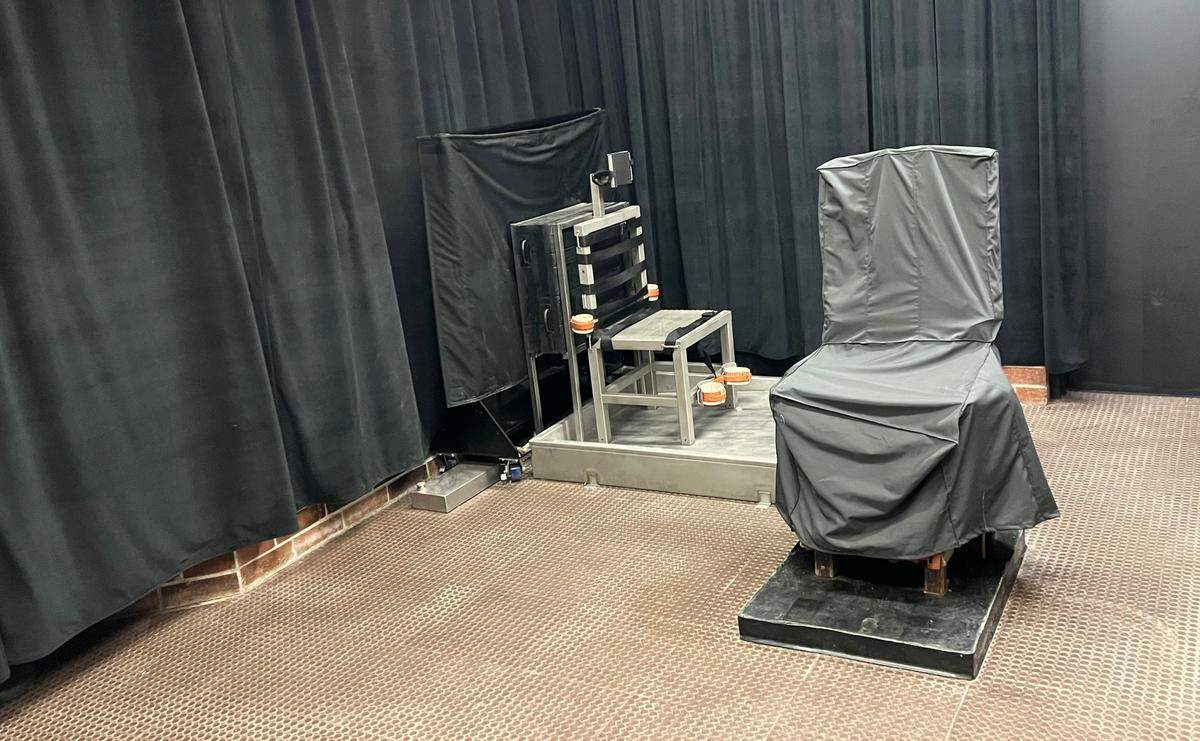
Since executions resumed in September 2024, three of the five men put to death have chosen to die by lethal injection. But recent court filings have raised the concern that the state’s use of the drug pentobarbital causes pulmonary embolisms — a painful death where lungs fill with fluid.
A spokesperson for McMaster issued the following statement, “the governor has high confidence in the leadership of the Department of Corrections. He believes the sentence of death for Mr. Mahdi was properly and lawfully carried out.”
In their letter, Bamberg and Collins say their hope is that an investigation can be part of a process of making the death penalty in South Carolina more transparent and accountable.
“We must ensure that all executions are subject to proper oversight, including independent forensic review and legislative access to witness the proceedings,” Collins and Bamberg wrote in their letter.
What went wrong with the firing squad?
Witnesses say that, initially, Mahdi’s execution appeared identical to the killing of Brad Sigmon, the first person to choose the firing squad. Mahdi was dressed in a black prison uniform and strapped to a chair inside the state’s death chamber. A strap ran around his chin, and a white paper target was pinned to his heart.
Protocol from the state Department of Corrections, which carries out executions, required that Mahdi’s heart be located by a physician using a stethoscope and chest X-rays, according to court filings.
The rifles are loaded with .308 Winchester 110 grain TAP URBAN ammunition. These bullets fragment on impact and are designed to cause fatal damage to internal organs. The three executioners are in a separate room from the death chamber and fire the rifles through gun ports. While firing squads have sometimes held a tradition of not loading some of the rifles so that the gunmen are unsure who fired the kill shots, the S.C. Department of Corrections has confirmed that all three rifles are loaded for executions.
An autopsy report commissioned by Mahdi’s legal team found he was struck by only two bullets, not three. The bullets hit the “lowest area of the chest,” rather than his heart, according to the report.
Mahdi’s attorneys were also critical of the state-sanctioned autopsy, performed by forensic pathologist Bradley Marcus, who concluded that two bullets entered the same wound and traveled along the same path. The autopsy showed no exit wounds.
During the autopsy, Marcus found metal bullet fragments and noted that the path of the bullets ran through the liver, pancreas, the heart’s lining and one of its chambers.
“It is predictable that the heart might not be injured severely (or even at all) from those shots, and that the majority of the internal damage would be to organs and structures in the upper abdomen or the lower portions of the lungs,” wrote Jonathan Arden, a forensic pathologist hired by Mahdi’s attorneys to review the autopsy.
Marcus only took one photograph of Mahdi’s wounds, which did not capture close up detail, and performed no X-rays on his body, according to the court filing.
“I have reviewed hundreds of autopsies, including for death penalty cases, and I’ve never seen seen one where they only have only one picture of the wound,” Bamberg said.
This story was originally published May 13, 2025 at 4:22 PM.