Clemency petitions for South Carolina’s double murderer given to Gov. McMaster
Less than a day remains until the scheduled execution of double murderer Stephen Stanko on Friday at 6 p.m. In hopes that South Carolina Gov. Henry McMaster might grant him clemency, members of advocacy groups delivered petitions to his office with over 5,000 signatures.
Advocates led by South Carolinians for Alternatives to the Death Penalty gathered at the State House on Thursday for a press conference and to deliver four petitions to the secretary of the governor’s office. The petitions were from groups including Death Penalty Action and the Catholic Mobilizing Network.
“We believe that nobody should be executed, not just because of the different particulars of their cases,” organizer Rev. Hillary Taylor said during a Thursday press conference. “It’s ineffective, it’s costly and it’s the least effective way for people who are victims of violence and trauma to heal.”
Unless McMaster intervenes to change Stanko’s sentence to life without parole, Stanko will be the sixth person executed in the nine months since executions resumed in South Carolina after a 13-year pause.
The governor hasn’t granted clemency to any death row inmates, including Richard Moore, whose petition for clemency received over 50,000 signatures and included plea letters from two jurors who convicted him.
“We don’t know what case it would be, but we hope that Gov. McMaster will eventually change his mind and will commute somebody’s death sentence to life without parole or any alternative sentence,” Taylor told The State.
McMaster was not in his office Thursday to receive the petitions. His weekly schedule says he is in Nashville, Tennessee.
“I don’t believe there’s a thing in the world that would change Gov. McMaster’s mind,” said Ron Kaz, a member of Amnesty International. “Probably the only conceivable thing would be if God himself came down and spoke to him directly and said, ‘Do it.’ … Nothing has any impact on him.”
Advocates said during a Thursday press conference that execution does not make South Carolina safer.
“If executions made us safer, we would have been one of the safest states in the country long ago, but that is not our reputation as a state,” Taylor said. “The death penalty is a distraction from investing in all the things that do make our state safer, quality mental health, first aid and drug rehabilitation programs, restorative justice diversion programs, more robust victim service providers.”
Stanko has been on South Carolina’s death row for 20 years since being convicted of two separate killings in 2005.
He received two death sentences at separate murder trials. He was convicted in Georgetown County in 2006 for the murder of his girlfriend, Laura Ling, in her Murrells Inlet home. He was also sentenced to 110 years for sexually assaulting and slitting the throat of Ling’s daughter, who survived.
In 2009, Stanko was sentenced to death again in Horry County for the murder of his friend Henry Lee Turner in Conway.
Advocates said experts diagnosed Stanko with severe brain damage resulting from several injuries.
Stanko’s brain damage resulted in tissue loss in the left frontal lobe and medial brain structures that place him in the bottom 2.4 percent of the population, Taylor said during Thursday’s press conference. She added that death row inmates with brain damage receive “little to no help” from the state for them to recover and rarely have access to quality legal representation.
He discussed his brain injuries and showed the extent of the damage through MRI scans to a pen pal while in prison. Freeman Voyles, who exchanged letters with Stanko and described their relationship as a “fruitful friendship,” said he doesn’t dwell on his circumstances and finds prison life “peaceful.”
Advocates would’ve preferred Stanko receive life in prison without parole or life in a contained environment, Sister Pamela Smith of the Catholic Diocese of Charleston told The State. Some behavioral controls are lost for people with severe brain injuries, she added.
Controversy over South Carolina’s execution methods
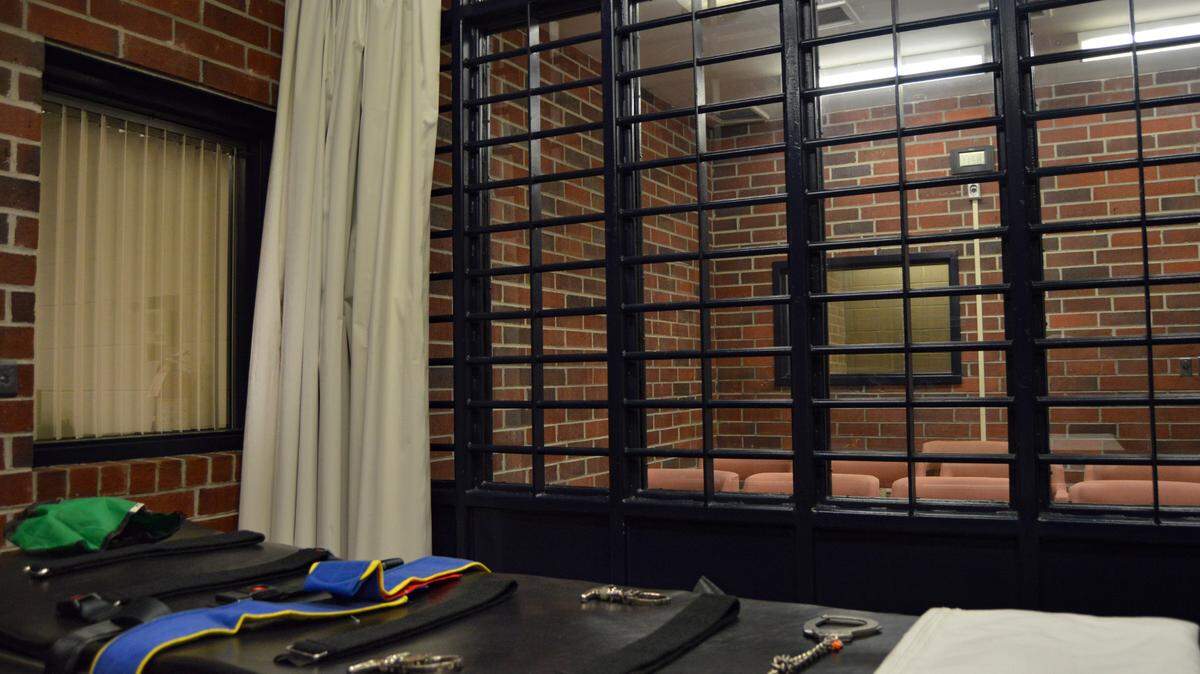
Stanko selected lethal injection as his method of execution May 30.
Part of his decision, according to his lawyers, had to do with recent discussions in the state over whether execution protocols are ethical. It comes after attorneys submitted evidence of a “botched” firing squad execution of Mikal Mahdi. He was the most recent person to be executed in the state, and survived for several seconds after being shot.
The Department of Corrections has denied the claims made in the lawsuit.
Concerns have also been raised by experts about South Carolina’s lethal injection protocol, which calls for two massive doses of the powerful sedative pentobarbital, The State reported this week. South Carolina is the only state that uses two five-gram doses of the lethal injection drug, according to one of Stanko’s lawyers, who filed the lawsuit. Some warned that the protocol might constitute unconstitutionally cruel and unusual punishment.
“That is what we cling to, is the possibility that it might,” Taylor said on whether the controversy might influence McMaster’s decision.
The federal government, which also uses pentobarbital in executions, paused use of the method in the final days of the Biden administration. It remains under review for federal executions.
“There’s no moral way to kill a human being,” Kaz said. “It doesn’t matter what sort of protocols and procedures you have. If you’re killing a human being, you’re engaging in something that’s morally repugnant.”