Why you should vote no on Beaufort County’s 1% transportation sales tax | Opinion
READ MORE
Candidate Q&As
Opinion team interviews for the Nov. 5, 2024 general election
Expand All
Beaufort County is at it again, asking voters to approve a so-called penny tax for various transportation projects on Nov. 5. This comes on the heels of county government’s 2018 1% tax of which only 12% of projects have been completed.
We cannot afford the county’s wish for another $950 million to mismanage. Taxpayers should vote “no” on the new 1% sales tax and its accompanying $515 million bond (questions 1 and 2) for several reasons.
The “penny tax” wording is a gross distortion of the true costs. Using the county’s $950 million, 10-year figure and its current population of roughly 200,000 people, and assuming a projection that 40% of the sum would be paid by visitors is accurate, the so-called penny tax will cost each resident $285 a year. It would cost a family of four who lives here $11,400 over the 10-year life of the tax. That is far from a penny!
Also, if we vote yes, the county will assume that we have approved the projects. But we have not yet seen the details to determine if we like or dislike them. By the time we do see the details, it will be too late — we will have lost our leverage.
The county promises a Citizens Led Oversight Committee, but it is doubtful that County Council can be trusted to run or staff any oversight committee. County Council is led by members of a secretive and biased Chamber-linked group (The Greater Island Council) that just succeeded in electing another crony to the county transportation committee. Any audit or oversight would quickly become a crony-stacked rubber-stamp sham, just as all county “independent” studies have become. It is much wiser to make the county provide more design and visual detail on each project before we vote to approve them.
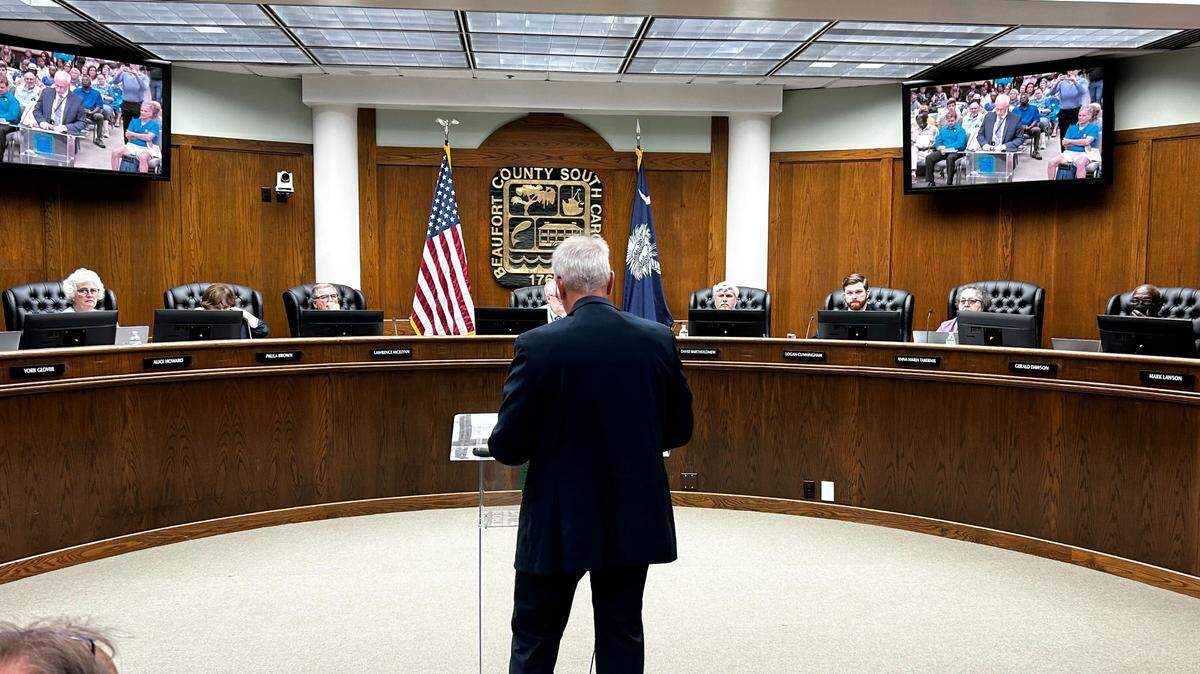
The county has also shown little ability to honor public concerns. For example, when citizens and a town councilperson appealed to County Council to recognize their concerns before an important vote at a 2022 County Council meeting, Council Vice Chair Larry McElynn told them to address the council after the vote: “We are not going to vote on your comments, whether you like it or not, we’re not going to, but we’re going to let you make those comments, if you’d like to, at the end of the meeting.”
Likewise, the county has shown no talent for risk and budget management. For example, the largest project in the 2018 tax referendum, the U.S. 278 Corridor Improvements Project, started as supposedly “fully funded.” Since then, its costs have more than doubled, with a shortfall rising to $190 million. That is so large that not even this 2024 tax referendum will cover it. Furthermore, the corridor project will not go out to bid until summer 2027. Recall that when the Hilton Head Airport terminal went out to bid, its costs ballooned, far exceeding estimates. That is likely on this project. Like Godzilla, it will eat every available tax dollar in the county. It will displace other worthwhile projects and still not have enough funds. Yet the county’s head-in-the sand planning continues. Assistant County Administrator Jared Fralix said in August that Beaufort County is “definitely resilient” and that he had “no fear” about the project.
There are other strange things going on. The county’s description of the referendum projects totals $950 million. But the projects on their list only total $900 million. There appears to be $50 million unaccounted for. So much for fiscal transparency.
Quite frankly, Beaufort County cannot be trusted with our tax dollars. Several independent journalists have repeated that assertion. One wrote, “It is impossible to overstate how little trust Beaufort County government deserves right now.” Five ex-county councilpersons have said similar things.
Making massive amounts of cash available to vague projects will encourage the county’s already dictatorial and irresponsible planning and management.
There is no reason for taxpayers to provide a 10-year blank check to a list of projects with unknown details and impacts. It is much wiser for citizens to demand that these projects be addressed in smaller, more transparent bites, subject to our pre-approval only after we see a higher level of detail for each project.
This story was originally published October 15, 2024 at 9:00 AM.