Women in politics: How SC courts ‘lose the respect and integrity of the public we serve’
READ MORE
Women in politics
South Carolina set a record with six “sister senators.” Now it has two. Columnist Matthew T. Hall asked why.
Expand All
In 2009, the national League of Women Voters set to work to “promote the importance of fair and impartial courts nationwide” and focused on “diversity at all levels of the state judiciary to enhance the legitimacy of our system of justice in the eyes of an increasingly diverse public.”
A brochure highlighting the problem in South Carolina, where judges are elected by state lawmakers, was eye-opening, to say the least.
It revealed that only 22% of South Carolina’s judges were women, even though women comprised nearly 35% of the state’s lawyers and 52% of its population.
It also reported that only eight (or 7%) of the 118 judgeships were occupied by a minority.
The problem hasn’t substantially improved in South Carolina despite a national spotlight.
Last year, when lawmakers elected a woman to replace a retiring Black justice, an Associated Press headline blared, “South Carolina is trading its all-male Supreme Court for an all-white one.”
An issue of public trust
In 2016, the Brennan Center published a guide for judicial selection committees like the one South Carolina created in 1997 to help vet candidates for judge. South Carolina’s situation is unusual because only it and Virginia elect judges through legislative votes. Other states do so through partisan or nonpartisan judicial elections or gubernatorial or other judicial appointments.
Titled “Building a Diverse Bench: A Guide for Judicial Nominating Commissioners,” the Brennan Center’s handbook lays out four reasons why courtroom diversity is so crucial.
The guidance said:
Bringing diverse perspectives to bear fosters decision-making that reflects the lived experiences of the whole population, resulting in better, richer jurisprudence.
A diverse bench also promotes public confidence that the judicial system is fair and objective.
When the judiciary includes all voices and perspectives, members of the public are more likely to trust that theirs will be heard as well.
Diversity on the bench has the added benefit of establishing role models for all groups by showing that individuals from diverse backgrounds can obtain judicial positions.
It barely registered in South Carolina or with the state’s Judicial Merit Selection Commission.
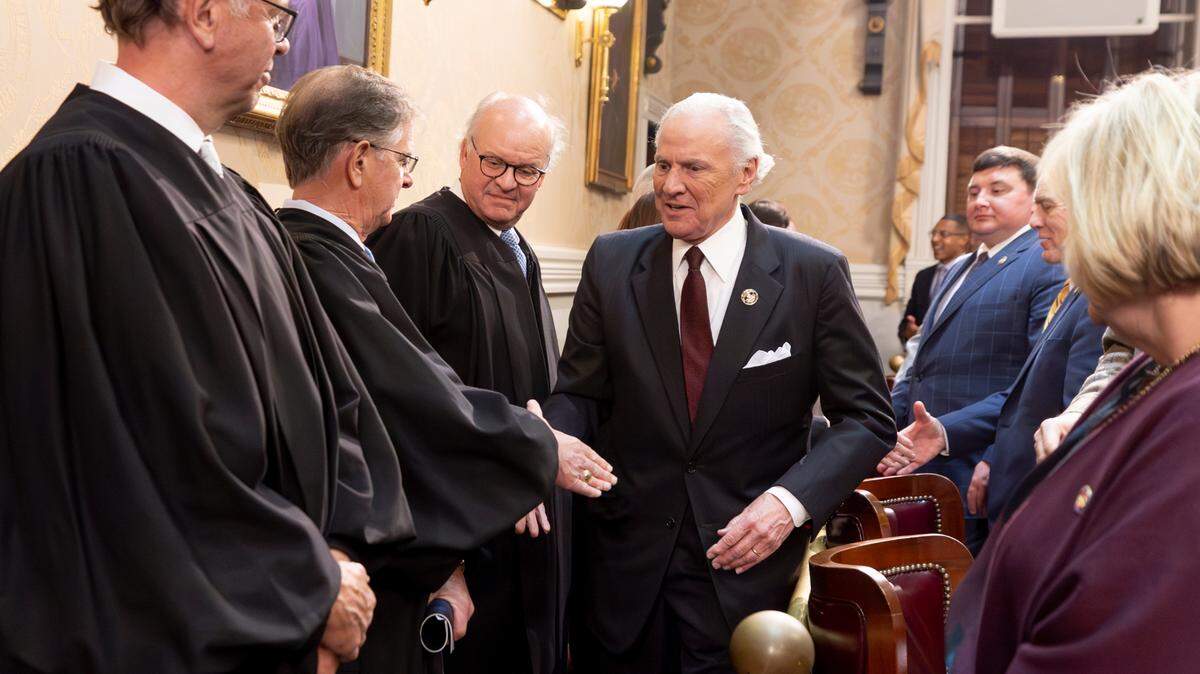
Then two years ago, in 2023, South Carolina Supreme Court Justice John Kittredge told lawmakers judicial diversity should matter. At the time, South Carolina was the only state without any women on its Supreme Court. Now Kittredge is the state high court’s chief justice.
“We have a great system,’ Kittredge told lawmakers. “But if it does not reflect the people of South Carolina, we are going to lose the respect and integrity of the public that we serve.”
He added, “That belief by the public in the integrity of our judicial system is absolutely critical to a functional, working and fair justice system for all South Carolinians.”
As Martin Luther King Jr. once said, “The arc of the moral universe is long, but it bends toward justice.” So it was that in 2024, the South Carolina Black Legislative Caucus called renewed attention to the lack and the importance of representation in the judicial system.
“This isn’t merely about representation for its own sake,” Rep. Annie McDaniel, D-Fairfield, said then. “It’s about enriching our judicial system with various perspectives that enhance the fairness, I say fairness, and impartiality of judicial decisions…. As we consider the implications of our current judicial demographics, it is essential to recognize that diversity is not merely symbolic. It directly influences the trust that our communities place in the judicial system.”
An inherent problem
The commission evaluates and interviews candidates and those who know them or work in the legal field to determine their qualifications in a number of areas. Much of the process occurs out of public view, and many records are confidential though candidate interviews are made public.
The interviews show the skills and seriousness of candidates and commission members alike.
Yet, in the past, the General Assembly has sometimes ignored the panel’s recommendations.
Earlier this year there was one race with a qualified, unopposed candidate who actually lost her election. The vote to approve her wasn’t even close. It failed in the General Assembly 54-93.
That’s despite the Judicial Merit Selection Commission finding no red flags in her background.
One commissioner even told her, “You’re going to do a great job.”
But lawmakers never gave her a chance. That vote was the second time in 10 months that the General Assembly rejected a lone candidate who had support from the selection commission.
As I’ve written before, it’s an inherent problem with the selection process that the group of lawmakers who decided her fate was only 12.9% women — including just two female state senators (out of 46) and 20 female representatives (out of 124).
An imbalance of power
It’s also a problem that more than 1 in 4 of the lawmakers electing judges are lawyers who could appear before them in court. Lawmakers shouldn’t have an outsized role in selecting judges, and that’s especially true for lawyer-legislators with such an inherent conflict of interest.
Gov. Henry McMaster made that point in a July 2024 letter to Senate President Thomas Alexander to explain why he signed a bill making minor selection process changes when more are needed. Under the new process, the governor appoints a third of a slightly larger Judicial Merit Selection Commission.
Three lines from McMaster are worth reflecting on as we discuss a judiciary that should reflect the state.
McMaster wrote that, “Entrusting a single branch of government with effective control over the screening and selection of candidates and exclusive control over their election is not only inconsistent with the separation-of-powers principles enshrined in our Constitution, but it has created the public perception that the process elevates a candidate’s influence and connections over merit and objective qualifications.”
He wrote that, “Such requirements as assuming a campaign post in the lobby or at the bottom of the escalator in the hope of speaking to a legislator as they hurry by to do their work discourage many capable but apolitical attorneys from seeking judicial office.”
And he wrote that, “No good argument can justify maintaining or merely tinkering with the status quo. Continued resistance to meaningful change will only further elevate the current perception and exacerbate the actual imbalance of power.”
He’s right.
South Carolina’s judicial selection process needs an overhaul.
This is the sixth in a series exploring South Carolina women in politics. Please read the others. Say hi on email or Bluesky.