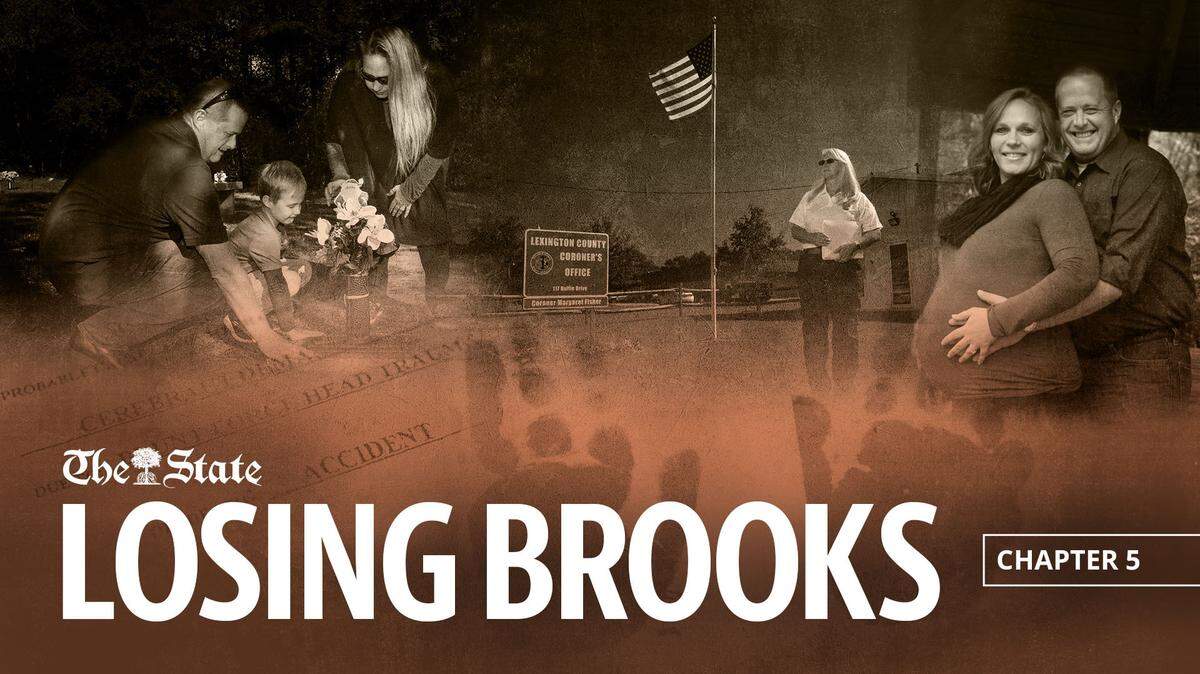
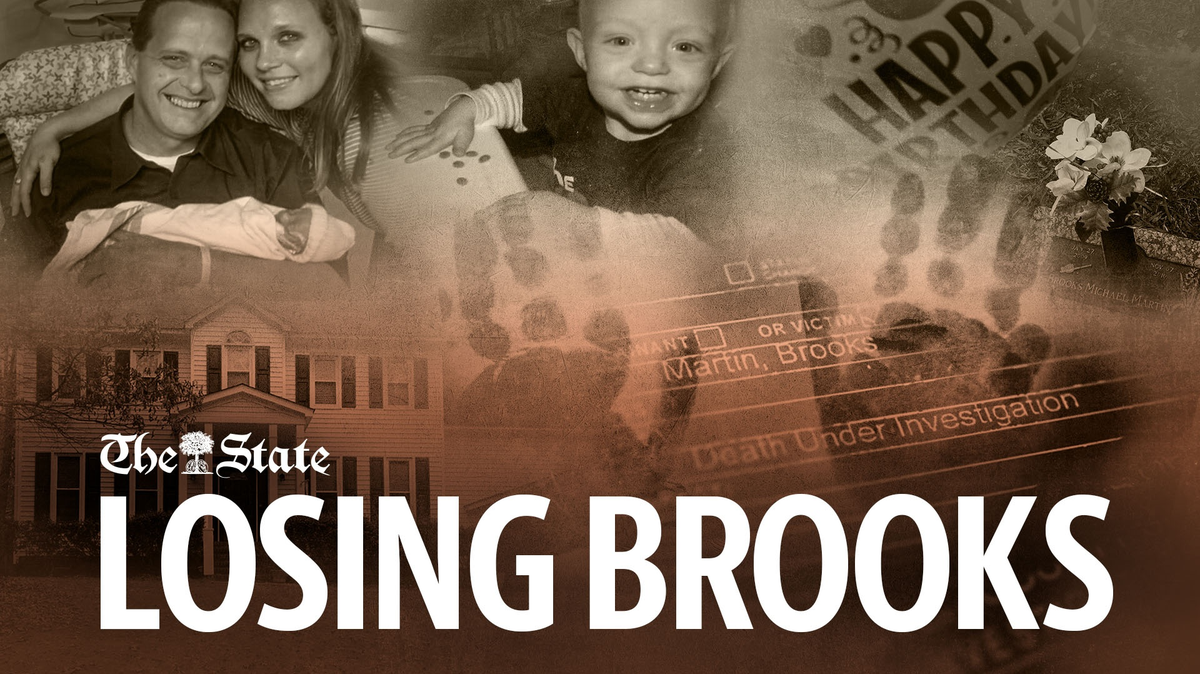
Would there be a trial? SC parents left with choice as officials argue over son’s death
READ MORE
Losing Brooks: Did an accident kill their baby boy 10 years ago? His parents believe it was homicide
In November 2010, Amy and Tim Martin lost their 21-month-old son after an incident at a home day care in Lexington County, South Carolina. The homeowner says that the baby fell down the stairs but a doctor told the Martins that the baby’s injuries were intentional. After two police investigations, Brooks’ parents are left with more questions than answers.
Expand All
After Lexington County Sheriff’s Department ruled 21-month-old Brooks Martin’s death an accident, Brooks’ parents pushed the state to investigate. SLED Agent Patsy Lightle reinvestigated the case. Sheriff’s officials and SLED agents clashed over the case. Eventually, SLED arrested Michael Creech, who was the only adult with Brooks when he was injured, charging him with homicide by child abuse. Debra Moore got ready to prosecute the case.
Debra Moore was a prosecutor who had a reputation for taking on the tough child abuse cases.
On April 19, 2011, she walked from her office through the halls of the 11th Circuit Solicitor’s Office in the Lexington County Courthouse to a wooden door with the nameplate “Deputy Solicitor Rick Hubbard.”
Michael Creech had sat in jail for three days on a homicide by child abuse charge alleging that he had caused the death of 21-month-old Brooks Martin.
Creech had told police that Brooks climbed out of his playpen and fell down the stairs at the home day care Creech and his wife operated in Irmo. Brooks had severe head trauma and retinal hemorrhaging, which doctors said was unlikely to occur from a fall down stairs.
Moore was going to argue in court that Brooks’ death was no accident. She had reviewed the South Carolina Law Enforcement Division investigation and believed the medical evidence for the child’s death being intentional was solid.
“I would have tried this case,” Moore said. “I would have convicted this guy. Period.”
She wouldn’t get the chance to present the evidence in court. Hubbard fired Moore. He was following orders of then Solicitor Donnie Myers, Hubbard told Moore.
“They said they ‘couldn’t control me,’” she recalled.
Myers referred The State to Hubbard for comment about the case and Moore’s firing. Hubbard, the current solicitor, would not comment for this story.
Another Lexington County prosecutor, Suzanne Mayes, took over the case from Moore.
Today, Moore believes she was fired for pursuing a trial for Brooks’ death because it would have required her pointing out serious flaws in the investigation done by the Lexington County Sheriff’s Department.
Moore’s firing was one of many setbacks that beset the case.
For the next year, the case would continue to be tangled in a collision of alleged investigative missteps, different interpretations of facts and medical evidence, and power struggles between prosecuting offices. Caught in this crash was a family trying to find closure in their son’s death and rebuild their lives.
Along the way, Michael Creech was released on bond after eight weeks in jail. He was facing a trial that could put him in prison for life.
In the end, the Martins would have a choice to make.
‘A HUGE ERROR’
The problems in the case started the first day of the Lexington County Sheriff’s Department’s investigation.
On the day Brooks was injured at the home day care run by the Creeches, sometime after the ambulance had sped away, Michael snatched a portable playpen from the upstairs room.
He went down the stairs that Brooks was said to have fallen down with the playpen in his hands and walked out of his house.
Creech threw Brooks’ playpen into the backyard along with two other playpens, high chairs and toys.
After a Lexington County deputy arrived at the Creeches’ home that evening, the deputy saw the scattered items and called it in to Detective Marty Longshore, police reports indicate. Longshore was interviewing the Creeches and Brooks’ parents at the children’s hospital.
He asked Michael Creech why he had thrown the items into the backyard.
“I don’t want another child that’s not ours ever in that House,” Creech wrote in a police report. “I wanted to get rid of everything that Reminded me of that Daycare.”
When exactly Creech threw out the items is unclear. But he altered the scene before police arrived.
Creech got to the hospital with his wife about 11:30 a.m., about an hour after Brooks was injured. Creech’s wife told police that her husband never left the hospital and that she only left to pick up her daughter and returned.
But the Martins contend that Creech left the hospital and went back to his home.
A family member of the Creeches arrived at their house at 3 p.m. and told a deputy, who arrived at about 7 p.m., that Michael Creech “went through the house putting all of the children’s toys outside in the backyard,” according to a police report. The report isn’t clear about when Michael Creech did that.
But no matter when Creech threw the items outside, it baffles private investigator Brian Setree why Lexington County deputies hadn’t been on the scene before then.
With his short-cropped, graying hair, Setree still has the look of a Lexington County sheriff’s deputy that he was eight years ago.
Setree, who has known Moore for years, worked with the Martins to help them get more information about their son’s death.
He can’t understand why an officer didn’t get to the Creeches’ house within a short time of the 911 call, he said.
Although EMS was called about 10:30 a.m., police were not called to the hospital until just before 6 p.m., according to police reports. The first deputy showed up at the Creech’s house at 7:15 p.m.
“That’s a huge error,” Setree said about the delay in deputies arriving at the scene. “They have a scene and it wasn’t secured.”
Setree said he doesn’t know whether the late arrival was the fault of paramedics not calling deputies or not waiting on them, or if the dispatch center made a mistake and didn’t inform deputies, or if the department simply failed to follow standard procedure.
Former Lexington County Sheriff Jimmy Metts, who led the agency at the time of Brooks’ death, said, generally, that getting to the incident scene promptly is tantamount in an investigation.
“We want to arrive at the scene as fast as we can,” Metts said. “We want to see things as they were, not as they could have been.”
Metts reasoned that the delay wasn’t caused by his investigators neglecting to follow investigative procedures. Instead, he explained that deputies were called to the hospital, so they responded to that location and had to figure out what was going on to then respond to the location of the incident. Search warrants had to be obtained, which took time. Metts said his investigators followed “all the processes that you’re supposed to.”
But Metts’ explanation for the delay in getting to the scene doesn’t jibe with Setree’s experience as a Lexington County deputy under Metts’ administration.
“Anytime you have a situation involving a traumatic injury or accident — whatever — they’re gonna send a police officer,” he said. “They always do, they always have. If they didn’t, then that’s not normal.”
Yet even after deputies showed up to the Creech home, they didn’t confiscate evidence like the playpen or baby gate, which was said to be at the bottom of the stairs when Brooks was hurt, according to reports.
A crime scene investigator photographed the inside and outside of the house that first day but didn’t seize the items even though they had permission from the Creeches, according to police reports.
Investigators had to obtain a second search warrant three days after Brooks’ injury to re-enter the home and take the items as evidence, police reports show.
The Creeches’ dog got to the items and damaged them before the CSI unit had logged them as evidence, reports show.
Lexington Sheriff’s Department officials were concerned about the performance of the CSI unit around the time of Brooks’ death, according to internal documents.
In performance reviews from 2010 and 2011 for Lt. Scottie Frier, who led the investigative division at that time, problems with the CSI unit continually came up.
The 2010 review said CSI “continues to be an issue” and referenced internal problems and “their freedom in scheduling,” but didn’t provide details.
“If we continue to ‘just do our job’ we may fail,” a review said. “CSI … need(s) help.”
In a March 2011 review, about three months after sheriff’s investigators ended their investigation into Brooks’ death, a department official wrote that CSI needed Frier’s constant attention.
“The CSI Unit CANNOT just be left alone and function on their own,” said the review, which rated Frier’s performance in that category as slightly below “exceeds expectations.”
The review did not provide details of the CSI unit’s issues, nor did it mention the Brooks Martin case.
Frier declined to comment for this story.
EXAMINATION
Questions followed the case into the medical examination room where Brooks’ body was autopsied.
It’s questionable whether Dr. Kelly Rose, who performed Brooks’ autopsy, should have done the procedure without supervision.
Coroner’s offices enlist the services of certified forensic pathologists to do autopsies that are part of police investigations.
In 2010, when Rose performed Brooks’ autopsy, she was not a certified forensic pathologist.
Lexington County Coroner Margaret Fisher described Rose performing a forensic autopsy without certification in 2010 as a “big problem.”
Having a non-certified forensic pathologist do the autopsy on a child who died of suspected abuse “is not what you would want to do” normally, said Fisher, who was elected in 2014.
Dr. Janice Ross, who oversaw Newberry Pathology in 2010, said Rose was not certified by the pathologist accrediting board, but she was “board eligible,” which allowed her to do forensic autopsies.
Being board eligible meant Rose had sufficient experience to take the board certification test, but she hadn’t yet, according to Ross.
But the distinction between a regular pathologist and a certified forensic pathologist was significant enough that the Lexington County Coroner’s Office didn’t use Rose to perform forensic autopsies when she took over Newberry Pathology in 2019 until she was certified, Fisher said.
Records from the American Board of Pathology show Rose didn’t become a certified anatomical or clinical pathologist until July 2013 – almost three years after Brooks’ death. She was not a certified forensic pathologist until September 2019.
Dr. Rose did not return phone calls and messages from The State.
Her autopsy report for Brooks brought up more questions.
In her report, Rose made no mention of examining the inner parts of Brooks’ eyes during her autopsy, despite the diffuse retinal hemorrhaging doctors had pointed out as a sign of potential abuse.
There is no indication in her report that Rose spoke with Brooks’ doctors, who suspected abuse. Such talks also would have been part of a complete medical legal death investigation, according to Dr. Michael Caplan, a forensic pathologist who previously worked at the Medical University of South Carolina.
Rose’s ruling that Brooks’ death was an accident led Lexington County Sheriff’s Department to end its investigation.
Detectives Marty Longshore and others who worked the case never dug deeper into the conflict between Rose’s determination and Brooks’ hospital doctors, according to Moore, the first prosecutor on the case.
At the very least, the facts warranted a charge of child neglect, Moore said. But the sheriff’s department never took that step.
The sheriff’s department just did what it had to do to get through the investigation, Tim said.
“It just seemed at every turn of this investigation people were dropping the ball,” he said.
The investigation and Brooks’ autopsy were ammunition that could have imploded a trial for Brooks’ death.
“The way it was handled would absolutely make it difficult to prosecute,” Setree said.
To sow doubt in a jury, a defense attorney would only need to bring up the Lexington County Sheriff’s Department investigation that determined Brooks’ death to be an accident.
Without much physical evidence, like a weapon or blood at the scene, the prosecution would have to rely almost entirely on the medical evidence of non-accidental trauma.
But the defense could also try to refute doctors’ opinions by presenting Rose’s original finding, which said the child’s death was an accident. Or, as has been common in child abuse trials, the defense could put doctors on the stand who don’t believe retinal hemorrhaging to be a clear sign of inflicted harm.
Lexington County prosecutors would have to cross-examine the sheriff’s investigators, the very people they work with almost daily. And, ultimately, the prosecution would have to say to a jury of Lexington County residents that their own sheriff’s department was wrong to determine that Brooks’ death was an accident.
“The solicitor’s office didn’t want to throw the sheriff’s department under the bus because they had to continue to work with them,” Moore said.
Prosecutors would’ve also had to question why Rose deemed the manner of Brooks’ death an accident despite hospital nurses and doctors’ belief that the child’s injuries were non-accidental. Rose’s credentials would have to be questioned in the courtroom.
Lawyers would likely bring up the dispute between the sheriff’s department and SLED over Michael Creech’s comments in the hospital. SLED took Creech’s outbursts as a confession, while sheriff’s deputies believed he was filled with regret over not watching Brooks closely, Metts said.
All of that would have landed in newspapers and on TV.
A CHOICE TO MAKE
As the Martins waited for the next step in the case, they discovered a different kind of hope for a new life. Amy became pregnant in December 2011.
But two months later, when she went to the doctor for a checkup, she heard silence where a heartbeat should have been. She had a miscarriage.
It was Valentine’s Day 2012, shortly after Brooks would have turned 3.
As they found their way through the pain, the case against Michael Creech was collapsing around them.
The 11th Circuit Solicitor’s Office concluded that it would not prosecute the case because of the many conflicts it would have to deal with during a trial, Moore said. It handed the case over to the State Attorney General’s Office.
Prosecutor Heather Weiss took over the case.
What came next was a duel between an adamant investigator and a battle-hardened prosecutor. The joust came to a head in a June 2012 meeting.
The Martins and Lightle sat across a conference table from Weiss.
“It looked like two sides of a battle line,” Tim said. “We’re on this side. They’re on that side.”
Lightle had been so convinced by her findings that she pushed to prosecute Michael Creech with homicide by child abuse. But Weiss was skeptical. She didn’t think the evidence was enough to convince a jury beyond a reasonable doubt.
She showed Lightle a medical article that said injuries like the ones Brooks sustained weren’t always indicators of abuse, the Martins remembered. Lightle countered that the paper was widely criticized by medical professionals.
Laura Hudson, a prominent South Carolina victim’s advocate who was with the Martins at the meeting, asked if Brooks’ eyes could be re-examined by another forensic pathologist to confirm the nature of the retinal hemorrhaging, according to the Martins. The bleeding in Brooks’ eyes had been a key indicator of potential abuse, doctors said.
That meant Brooks’ body would need to be unearthed.
Lightle believed exhuming the body was possible, Tim Martin said. Weiss found the measure extreme and too late in the process, Martin remembered. Prosecutors were working with the evidence they had.
The Martins weren’t ready to make a decision on their son’s remains.
Looking back, Moore said the case definitely had flaws and contradictions.
“But all cases have issues,” she said.
Prosecutors have to fight the hard cases in court to let the jury decide, she said. It’s not about a jury having no doubts, she said — it’s about them having no reasonable doubts.
Weiss would ultimately have the last say in the decision. But at the meeting, the prosecutor asked Amy and Tim to choose the future of their son’s case.
You have one chance at a trial, Weiss told them, Tim remembered.
Would you present your child’s death before a jury with all the challenges, contradictions and disputes the case will face? Would you relive the trauma of the experience for a shot at a conviction?
You risk losing. And if you lose, you won’t get another chance to fight for justice for your miracle child.
Have you lost too much already?
Or would you forgo a trial for now and wait for an unforeseen piece of evidence, maybe a confession, to arise?
“If we would’ve known back then that 10 years later we would be in the same place, we would have taken that shot,” Tim said.
Tim and Amy chose not to go to trial.
On June 12, 2012, 19 months after Brooks died, the state dropped the charges against Michael Creech.
“Insufficient evidence to prosecute,” Weiss wrote in a court document.
Click here for Chapter 5 of Losing Brooks.
This story was originally published October 22, 2020 at 5:00 AM.