A top SC Democrat sent $550K in taxpayer funds to groups tied to girlfriend, her mother
READ MORE
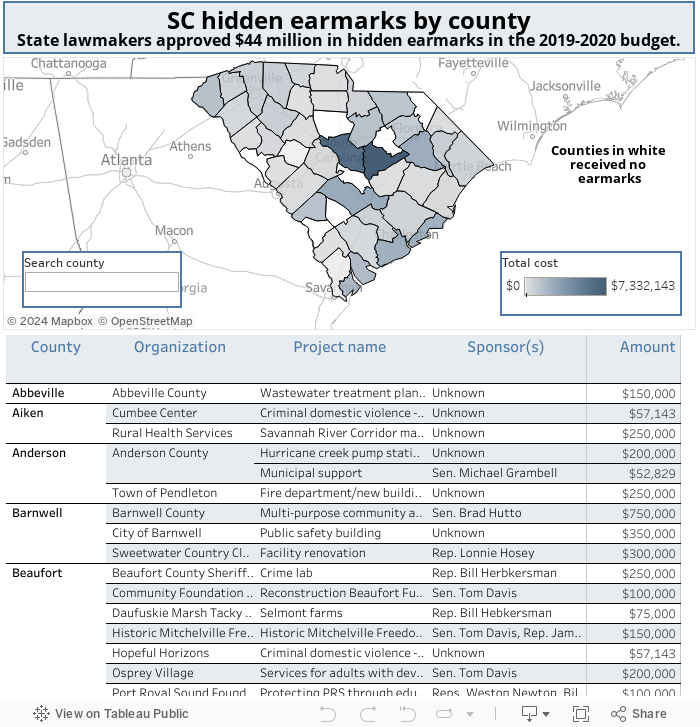
Hidden Earmarks
How millions in your state tax dollars are secretly spent each year.
Expand All
S.C. Rep. Todd Rutherford steered more than $500,000 of taxpayer money to organizations connected to his girlfriend, her mother and his ex-wife’s business partner through a budgeting process that is cloaked in secrecy.
The top House Democrat from Richland County sent $100,000 to a Columbia ballet company where his then-girlfriend, now his wife, served on the board and another $450,000 to a small counseling center in Charleston run by her mother. He also directed $20,000 to an event organized by a local entrepreneur, who co-owns a restaurant with Rutherford’s ex-wife, who is Richland County’s new coroner.
How did he manage it?
Like dozens of other S.C. lawmakers, Rutherford included hidden earmarks in the state budget, a controversial but legal process which lacks accountability and critics say is ripe for abuse.
There was little or no public discussion by legislators on the merits of the receiving organizations as they debated the state budget. There was no scrutiny of whether the earmarks achieved promised results. And there was no practical way for the public to know that their money was being sent to people close to legislators.
Rutherford, who represents portions of Columbia, isn’t the only one securing earmarks that raise questions.
For more than a year, a team of reporters at The State Media Co. and The Island Packet has investigated the secret world of earmarks, revealing payouts that pose potential conflicts of interests and questionable conduct by lawmakers from both sides of the political aisle and every part of the state.
For example, Sen. Greg Gregory, R-Lancaster, helped direct $1 million to a nonprofit run by his wife. Meanwhile, Sen. Darrell Jackson, D-Richland, funneled at least $850,000 in hidden earmarks to the nonprofit arm of the church he pastors.
Even lawmakers who have publicly denounced earmarks have secured them. Sen. Tom Davis, R-Beaufort, sent at least $1 million over two years to local projects after criticizing similar payouts.
Now, new reporting by the papers shows that in Richland County, Rutherford and Rep. Kirkman Finlay, a Republican, have funneled earmarks to their colleagues and friends.
“It’s unfortunate that our ethics laws ... allow conduct that I think is clearly unethical but not criminal,” said Sen. Wes Climer, R-York, an advocate for making earmarks more identifiable. “The General Assembly needs to fix it.”
Rutherford and Finlay’s earmarks would have remained hidden if not for an obscure document that linked them to the largest of the payouts. The document was obtained by reporters during a months-long review of earmarks records.
“(Earmarks are) the grease on the wheels of politics in South Carolina,” said state Sen. Dick Harpootlian, D-Richland. “... And of course, the more powerful you are, the more money you get.”
Rutherford is a 22-year veteran of the State House. Since 2013, the well-respected attorney has been elected to lead his fellow House Democrats as House Minority Leader. He serves on the powerful Ways and Means Committee, which helps craft the state budget, and the House Ethics Committee, which watchdogs House members to ensure they follow ethics rules.
Rutherford denies his earmarks are hidden and defends the payments, praising the causes he supported and noting the appropriations didn’t run afoul of state law.
“These are not hidden earmarks,” Rutherford said to a reporter. “They’re only hidden from the people that aren’t smart enough to know where to look to find it.”
Rutherford’s earmarks are legal, according to experts familiar with state law, and have benefited what some would consider worthy causes. But government watchdogs and some lawmakers take issue with the payouts’ lack of transparency and accountability, as well as the recipients’ connection to the lawmaker.
Earmarks can take months to track, if they can be tracked at all, according to the newspapers’ review. No publicly available list exists of all earmarks, their dollar amounts or all the lawmakers who request them.
Citizens are also waking up to the problems that the state’s earmark system poses.
“I think making earmarks clear and transparent would be a step in the right direction,” said April Jones, a community activist in Columbia and founder of the Pinehurst Farmers Market. “I think it’s important to have an open and honest society.”
Compounding concerns, South Carolina does not keep track of how all earmarked dollars are spent. Seventy-three percent of sampled earmark recipients failed to submit required expenditure reports during the past two years, according to a recent state audit that followed The State’s original reporting that lawmakers were sending millions to pet projects.
That’s the case for some of Rutherford’s earmarks. Only a patchwork of documentation could be found, outlining how the money was used. The counseling center would not supply additional financial information requested by reporters, though its director assured a reporter the organization has been a good steward of the public dollars.
Rutherford sent $450K to nonprofit of girlfriend’s mother
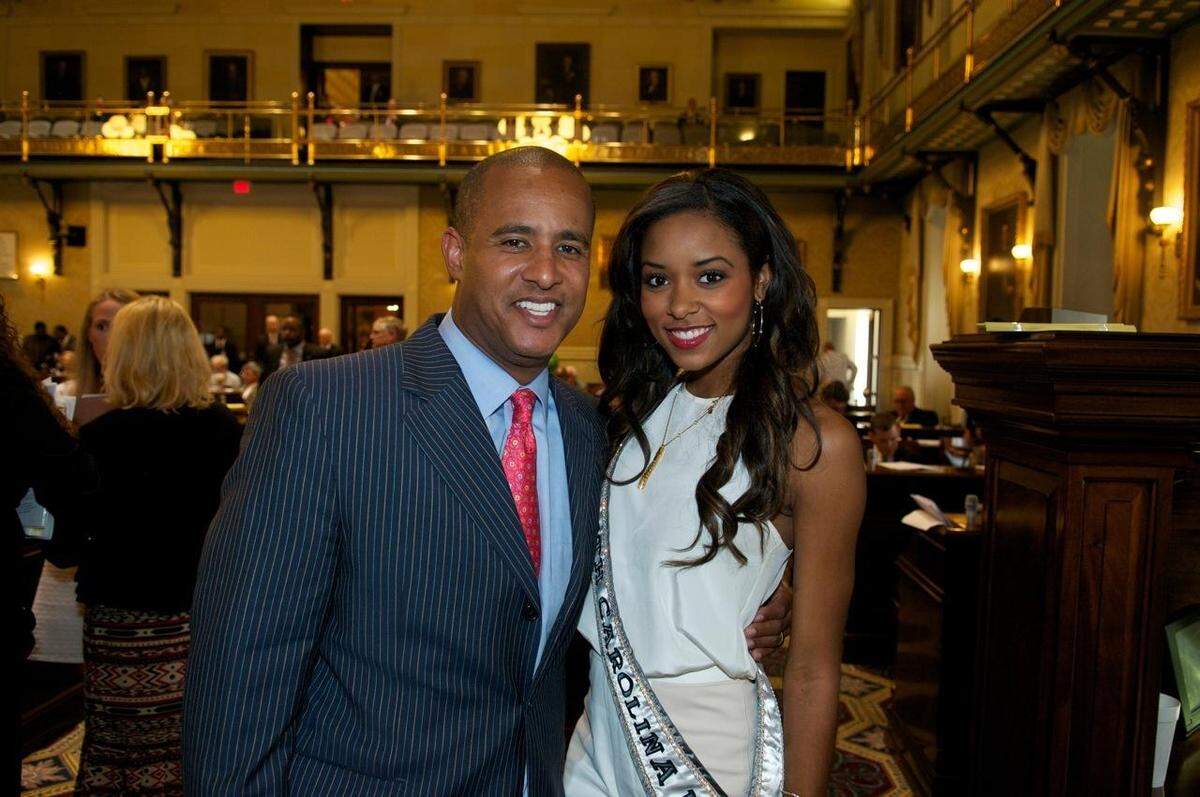
Rutherford has tapped hundreds of thousands in earmarks for causes tied to his now-wife, Megan Pinckney Rutherford, a model, social media influencer and 2013 Miss South Carolina USA. She was also the 5th runner-up in the national Miss USA contest that same year and worked as Rutherford’s legislative aide.
For years, the money almost single-handedly bankrolled a small nonprofit run by Pinckney Rutherford’s mother that is more than 100 miles away from Rutherford’s Richland County district, records show.
Sabrina Pinckney founded On Solid Grounds, a Charleston-based nonprofit which offers counseling and preschool assistance to families and children, in 1999. She ran the organization, working as much as an average of 85 hours a week, according to tax filings, while also working as a full-time guidance counselor in the Charleston County school district until her retirement last year.
In an interview, Todd Rutherford said he learned of the organization through Pinckney Rutherford, who he was dating at the time, and Charleston lawmakers who knew of the nonprofit’s good work.
Some of the earmarked dollars benefited the nonprofit’s intervention program, aimed at helping teen mothers become self-sufficient and preventing additional unwanted pregnancies. But the program sputtered in recent years, according to Sabrina Pinckney’s own telling and a document obtained by the newspapers.
Several of the young mothers did not fully participate in the program after initially agreeing to do so, as they juggled school, jobs and new parenthood. And in 2018 and 2019, three of the seven participants had a second child, according to a report submitted to the state.
Even with two case managers and home visits, “we still could not close the gap like I felt like we needed to,” said Sabrina Pinckney in a December phone interview with a reporter.
“The girls, unfortunately, just kind of started dropping out of school,” she said, adding that she has suspended the program.
Sabrina Pinckney’s nonprofit offered the girls counseling, stress-coping techniques and activities to bond with their child — all paid for by earmarks sponsored by Rutherford, according to tax returns and agency records. That breaks down to more than $100,000 annually from 2016 to 2019.
A report the nonprofit submitted to the state said many of the girls’ problems “appeared to be deeper than what the program could address.” It also noted a one-year lapse in funding, despite the program receiving $450,000 over the four-year period.
That sum was a shot in the arm for the small counseling center. For at least the decade prior, it ran on a shoestring budget.
Between 2006 and 2016, the nonprofit took in only $6,094 in total revenue, all through small grants and donations, which funded a family literacy program and a summer camp, according to public tax records. Only $366 in taxpayer funds went to the group during that time.
The returns for some years, documenting the group’s finances, are left nearly blank.
As money comes in, nonprofit’s expenses grow
On Solid Grounds is run out of a small, one-story home on a tree-lined neighborhood street on James Island that is owned by Sabrina Pinckney’s parents, according to property records. For years, the nonprofit had no paid employees, and didn’t pay its directors, according to tax returns.
That changed after Rutherford and Megan Pinckney Rutherford started dating.
The group first received a $250,000 earmark in 2016, sponsored by Rutherford and routed through the S.C. Department of Health and Human Services. Lawmakers routinely stash millions of earmarked dollars in the agency’s budget before the money is sent to pet causes.
On Solid Grounds began paying occupancy costs and bought a van, among other unspecified expenses detailed in its 2016 tax return.
Over the next three years, it paid $30,150 in rent, more than $6,500 in landscaping costs and roughly $1,200 for janitorial services without changing addresses.
Sabrina Pinckney said the rent payments went to her father, who provided a discounted rate to her nonprofit, adding that no one lives in the home and that she is responsible for its upkeep. She declined to say exactly how much she was paid, referring a reporter to documents submitted to the state, which didn’t list salaries.
The organization also began paying its employees and board members, according to its tax forms. Collectively, Sabrina Pinckney, along with three to four other directors, earned between $42,000 and $58,200 annually between 2017 and 2019.
The only year tax forms specifically lists anyone’s salary is in 2018 when Pinckney earned $44,000, working an average 60 hours a week. Other board members, who worked no more than an average of 12 hours a week, earned nothing, according to the form.
The earmarked funds didn’t stop after the first payout.
In 2018, the nonprofit received another $100,000 for the teen pregnancy program. Then came another $100,000 earmark — also secured by Rutherford for unspecified capital needs — that was included in last year’s state budget as a “local law enforcement grant” from the S.C. Department of Public Safety. Neither the agency or the House Ways and Means Committee that ordered the payment could say what the money was supposed to be used for, how it was used nor who requested it.
Rutherford, however, acknowledged that he was behind the combined $450,000 for the nonprofit.
He and Megan Pinckney Rutherford married in December 2020. In an interview, the lawmaker’s wife said she had “absolutely nothing to do” with the funding given to her mom’s nonprofit.
Sabrina Pinckney said she was uncertain of Todd Rutherford’s role, explaining that she applied for a state grant and was selected.
“I’m not really sure about anything that he might have also supported or anything like that,” she said.
In South Carolina, lawmakers can request money be earmarked for any cause. The powerful chairmen of the House and Senate budget committees sign off on the requests, then bundle them under vague titles, such as “local law enforcement” and “sports marketing” grants in the state budget. The money is temporarily assigned to state agencies that didn’t request it, then sent to earmark recipients.
The result: Millions in earmarks flow each year to various organizations with little, if any, public debate. The majority of lawmakers don’t know what’s included in the earmarks, much less taxpayers.
Rutherford defended the requests and rejected the notion that the funding was obscured from the public.
“This follows the law, other programs like this follow the law and if people come back and ask me to do something to help out the Black children of Charleston, I’d be happy to do it and will do it repeatedly,” Todd Rutherford said.
Rutherford added he had no duty under the law to disclose his then-girlfriend’s connection to the counseling center and that their relationship was “no secret” in the General Assembly.
State law bars lawmakers from sending earmarks and other state money to family members and certain business associates. But it is silent on friends, romantic partners and partners’ relatives.
Ethics experts and some legislators say Rutherford may not have broken the letter of the law, but he violated the spirit it by not disclosing his ties for the sake of transparency.
“It doesn’t pass the smell test,” said John Freeman, ethics professor emeritus at the University of South Carolina School of Law, after learning about the earmarks. “It looks like what he’s done is he’s propping up an entity for the benefit of his (girlfriend’s mother), and using a heck of a lot of state money for that.”
Ballet becomes an interest
On Solid Grounds is not the only organization that appears to have benefited through its connection to the lawmaker.
Rutherford also channeled $100,000 to the Columbia City Ballet in November 2018, records show, bundled with several other unrelated earmarks that were vaguely categorized as a “sports marketing grant” in the state budget.
The money bought pointe shoes, repaired rotting set pieces that posed a danger to dancers and conserved molding costumes, according to the ballet’s director and a detailed report submitted to the S.C. Department of Parks, Recreation and Tourism, which disbursed the funds.
William Starrett, the ballet’s executive director, said he approached Todd Rutherford in part because the lawmaker’s girlfriend, Pinckney Rutherford, was on the ballet’s board. Starrett attended the couple’s engagement party in November 2019.
Pinckney Rutherford, a self-described consultant and digital content creator with more than 40,000 Instagram followers, was on the organization’s board that year, according to both the ballet’s website and tax forms.
Rutherford has “been a longtime supporter of the ballet. He is a big advocate for the arts,” said Starrett, adding the organization was grateful for the support. “We are terrific stewards of our funding.”

The 60-year-old ballet, which is the state’s largest performing arts organization, reported a $1.5 million yearly budget on the paperwork it submitted to get the payout. It also received a grant from Richland County and $175,000 in hospitality tax funding from the City of Columbia that year.
“It’s hurtful to watch as our arts organizations suffer as much as they do without adequate funding from the state, so I was happy to do it,” Rutherford said, adding that he and his wife were not married at the time of the appropriation, so the payout didn’t violate ethics laws.
The lawmaker dismissed questions about the link between the earmarks and his now-wife.
“That’s a stretch,” he said.
Before Rutherford, dating back at least a decade, the ballet received no earmarks from any S.C. lawmaker, according to state financial records.
Pinckney Rutherford said she is a vocal advocate for the ballet, a passion she shares with many at the State House.
“Had I not been part of that organization, would they not be supported? I don’t know.” she said. “And if I were supporting a different organization, would they find more support? I really don’t know. It’s a ‘what if.’ ”
Company of ex-wife’s business partner receives $20K
Rutherford also secured an earmark for a private business, run by Raquel Thomas. The Columbia entrepreneur has co-owned a restaurant, The Gold Den in northeast Columbia, with Rutherford’s ex-wife, Naida Rutherford, since 2019.
Naida Rutherford is familiar to Midlands residents. The nurse practitioner made history last June, becoming the first woman and first African American to be elected as Richland County’s coroner, defeating a 20-year incumbent.
Thomas, a self-described “serial entrepreneur turned community builder and servant” said the $20,000 went to her limited liability corporation, Dream Catchers Corporation, that promotes her personal brand. She used the funds to put on a November 2019 “business bootcamp” at the Columbia Metropolitan Convention Center that most attendees paid to attend.
“(Thomas) came and talked to me about giving a donation, and I thought that what she was doing for kids was amazing,” said Todd Rutherford, who acknowledged sponsoring the earmark.
Thomas first told a reporter she didn’t recall which legislator she worked with to secure the money, but later confirmed she pitched the idea to Rutherford.
“I have a relationship with many of the political powers ... in our city. I’m really active in the community,” said Thomas, who unsuccessfully ran for the Richland 1 school board last year.
Thomas also operates a clothing store in the Vista in Columbia, DMR Fashion, and a nonprofit, the Dream Catchers Foundation, that provides entrepreneurship programming for youth in the Midlands.
Naida Rutherford said she did not initially know that Thomas requested the earmark nor that her ex-husband secured it.
Adult participants paid $150 to attend Thomas’ event during which more than a dozen “business coaches” led talks on “marketing and branding, funding, non-profit organization, real estate investment, creating a business plan, building a budget, (and) business leadership,” according to an event description.
Tickets were $7 for “kidpreneur(s),” the event listing read. But most children attended for free, Thomas said, because she covered ticket costs for some students while colleges paid for others.
Former state lawmaker and current CNN political commentator Bakari Sellers headlined the conference. Naida Rutherford led a session called “Dressing For Success,” according to a promotional Facebook post, and was not paid for her time, she said.
The conference placed the “Raquel M.R. Thomas” business coaching brand front and center in promotional spots and on a royal blue banner at the back of the convention center stage.
In the state budget, the money that went to the LLC was lumped in with “local law enforcement grants” from DPS and was to be used for capital needs, records show. DPS officials and House staffers with the Ways and Means committee could locate no document showing who requested the money, its purpose or how it was spent.
Rutherford compared the event to a charitable fundraiser.
The LLC could be managed to “do nonprofit activity or to help out kids,” he said. “How it’s set up is of no concern as long as the work they’re doing is helping the citizens of South Carolina.”
Giving an earmark to an LLC is both uncommon and troubling, according to the newspapers’ review.
Of the 469 earmarks covering a five-year span reviewed by the newspapers, just 26 went to private companies, which aren’t required to publicly disclose any financial information or salaries. That makes tracking the money given to private businesses nearly impossible.
“A portion of the proceeds of this conference will go directly to continuing (Thomas’) work in the community,” reads the event description for the bootcamp.
But the conference didn’t make a profit in its first year. “We lost money on this event,” Thomas said.
The state money paid the event’s speakers honorariums that varied based on who they were and how far they traveled, according to Thomas.
“Unfortunately I wasn’t able to get paid, but that’s always the goal. Because it’s a business. The bootcamp is a business. It’s out of my corporation,” Thomas said, adding that the next iteration of the event is slated for the end of this year.
This story was originally published March 2, 2021 at 5:00 AM.