Millions of dollars in spending was excluded from SC charter district’s public reports
READ MORE
Unchartered Territory
Unchartered Territory is an ongoing series by The State Media Co. about South Carolina’s changing charter school landscape
Expand All
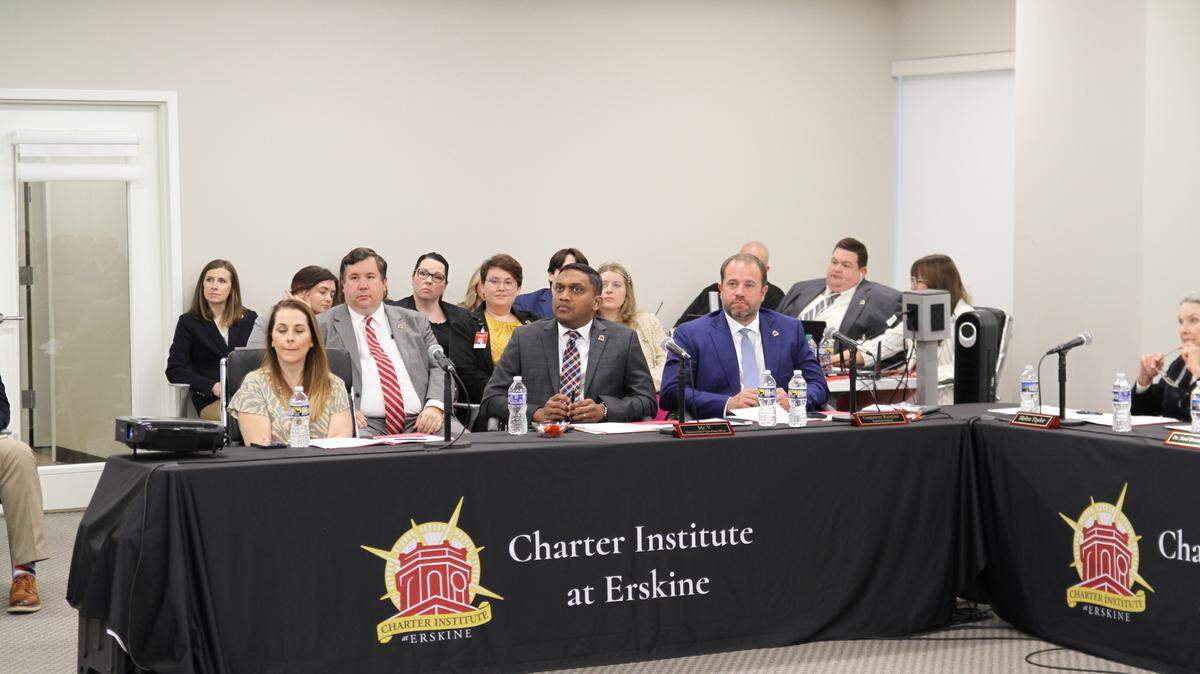
The Charter Institute at Erskine was an open book, its beleaguered leader Cameron Runyan assured state lawmakers two years ago.
“There’s no question about how we spend money,” Runyan retorted during a combative March 2024 committee hearing. “There never has been a question about how we spend money.”
The charter district superintendent, whose involvement in an aborted plan to open schools in Tennessee had come under intense questioning by a legislative panel that day, directed skeptics to visit his district’s website for a full accounting of its spending.
“You will see every single penny that we have spent at the Charter Institute posted on that website,” Runyan said.
A subsequent review performed by The State Media Co. found more than a few pennies missing.
Beginning in May 2024 — roughly a month after the hearing — and continuing for at least the next 18 months, the taxpayer-funded district’s online expense reports ceased including all checking account transactions, in effect, obscuring the scope of its spending.
More than 1,000 checks totaling $5.2 million, or about 72% of the district’s vendor payments, did not appear on financial reports the Charter Institute posted on its website during that period, an investigation by The State found.
The absence of the checks concealed payments to a wide range of vendors, including $2 million paid to its landlord and $1.7 million paid to consultants, lobbyists and law firms.
South Carolina school districts are required to post transaction registers on their websites that include a “complete record of all funds expended over one hundred dollars, from whatever source, for whatever purpose.”
Districts must post the registers each month in a downloadable format that includes the names of payees, transaction amounts and a detailed description of all checking account transactions.
The State filed a public records request for the Charter Institute’s full check registers last September, more than a year after most of its vendor spending had stopped appearing on the public reports.
The district replied about six weeks later by directing a reporter to the incomplete registers on its website, before quietly correcting the reports in mid-December.
When asked why expenditures had been excluded from the reports that were originally posted, a Charter Institute spokeswoman blamed a software glitch.
“An error in our accounting software resulted in those expenditures being excluded from the reports that are routinely uploaded to our Transparency page, despite the fact that all documentation was stored in our internal system,” spokeswoman Ashley Epperson explained in an email.
She said after discovering the error the district updated the reports, “in accordance with our continued commitment to providing transparent financials.”
More than $2 million in payments to landlord excluded
The largest chunk of payments excluded from the district’s expenditure reports were checks written to Hamilton Capitol Center LLC, owner of the Capitol Center office skyscraper across the street from the South Carolina State House.
The Charter Institute, which leases the building’s third floor and 25th floor penthouse suite, cut 25 checks to Hamilton totaling $2.13 million over the 18-month period reviewed by The State.
Only three of the 25 checks were included on the original transaction registers posted by the district, and two of them displayed an incorrect amount.
The Charter Institute paid Hamilton $450 on May 3, 2024, and $200 on Nov. 1, 2024, according to the district’s original check registers. When the reports were corrected late last year, the same checks ballooned to $22,798 and $25,346, respectively.
Epperson said the district’s accounting system was responsible for the fact that the size of some checks was originally misreported.
“The accounting system’s access credential error prevented the employee who pulls the reports from accessing certain account codes,” she wrote in an email. “When the credentials were updated, all the charges from that vendor across all account codes were then accurately reflected in the reports.”
The terms of the Charter Institute’s lease agreement at the Capitol Center were a point of concern raised in a recent district performance audit.
The Legislative Audit Council, which last year probed the Charter Institute’s spending and vendor relationships at the request of state lawmakers, questioned the wisdom of the district signing a 10-year, $7.5-million lease at the Capitol Center and spending an additional $1.24 million in taxpayer dollars renovating the space.
The agency’s report recommended the district “determine whether it may be beneficial to terminate its lease and move to another office space.”
Runyan, whom House lawmakers grilled about the lease at a recent budget committee hearing, defended the decision to rent the Capitol Center’s top floor.
Leasing the 20,399-square-foot space, which used to house the swank Capital City Club, decreased the Charter Institute’s net lease cost and created an “incredible resource” for the people of South Carolina, the superintendent argued.
“When you take the amount of revenue that we’re receiving from lease income from the event space, and when you take the amount that we don’t have to spend on external venues, our effective lease rate this year will be $7.23 a square foot,” or a fraction of what other state agencies pay to rent space in the same building, he said.
Original reports excluded nearly all payments to consultants, lobbyists and law firms
The district paid roughly $1.7 million to an assortment of consultants, lobbyists and law firms over the 18-month period reviewed by The State, with only one $3,500 payment appearing on a public check register.
It’s not clear in most cases what specific services the vendors provided the Charter Institute because the district did not directly respond to questions about them and does not include a description of its transactions on its public reports.
A law firm retained by the Charter Institute defended the district’s right to seek the advice and recommendations of specialized vendors, but said it would be inappropriate to disclose “the nature and substance of its confidential communications and advice exchanged” with those vendors.
“The Charter Institute respectfully requests The State acknowledge and respect The Charter Institute’s legal right to privacy, in regard to its expenditure of private funds,” attorney Barrett Brewer wrote in a five-page letter responding to The State’s request for basic information about the district’s vendors.
The Charter Institute is a publicly-funded school district, but has claimed to use private funds for millions of dollars in expenditures, including most recently, its legal and consulting fees.
The Legislative Audit Council examined some of the Charter Institute’s prior funding claims in its report, but failed to verify the district’s assertions. It found the district had banked only about $340,000 in private donations between July 2018 and June 2025, according to its report.
While auditors did not investigate whether the Charter Institute spent only private dollars on legal and consulting services, their report notes the district spent “large sums of money” on such services and advised that “further review of expenses may be warranted to ensure public funds were spent as efficiently and effectively as possible.”
The timeframe covered by the audit — July 2022 to June 2025 — includes most of the 18-month period reviewed by The State. Unlike the transaction registers the Charter Institute posted on its website, however, there is no indication the financial documents it provided auditors were incomplete.
After the district’s landlord, Cantey Tech Consulting was the next largest beneficiary of unlisted Charter Institute spending during the time period reviewed by The State.
Cantey, a Charleston-based IT services firm whose vice president served on the board of the Institute-affiliated charter network that explored opening schools in Tennessee, received nearly a half-million dollars, corrected spending reports show.
Two prominent law firms — White Story & Hicks and Smith Robinson — were also among the highest-paid vendors whose checks were excluded from the Charter Institute’s transaction registers.
White Story & Hicks, a leading education law firm that serves as the Charter Institute’s general counsel, was paid $189,000 over the 18-month span reviewed by The State, and Smith Robinson, a multipractice firm co-founded by S.C. House Speaker Murrell Smith, received $139,000, corrected records show.
Three other vendors that received six-figure sums were TW Educational Consulting ($171,485), Advocatus ($106,000) and Anne Louise Peterson ($102,104), according to corrected reports.
Tammy White, the consultant behind TW Educational Consulting, is the chief of planning and innovation for Teach Right USA, a teacher training and educational services firm the Charter Institute formed in 2023 and financially supported. As of June 2025, the district had covered more than $1.2 million of Teach Right’s costs and was owed nearly $400,000 by the firm, according to the Legislative Audit Council.
Advocatus is an education-focused consulting shop run by Jay W. Ragley, a Republican insider, former charter school management company executive and lobbyist for Gray Collegiate Academy, among other clients.
Peterson, a one-term Democratic state lawmaker who represented James Island and Folly Beach in the late aughts, has worked as a lobbyist for the Charter Institute since 2022, records show.
Both Ragley and Peterson were in attendance at a House budget committee hearing last month where Runyan defended the district’s spending on lobbyists.
He told lawmakers the district had hired lobbyists to counter the malign influence of some charter school management companies that deploy “an army of four, sometimes five lobbyists” to push policies that weaken charter school authorizers and cause distress in the sector.
While the superintendent didn’t directly address the committee’s questions about consultant spending, he cast doubt on the value of some educational consultants while discussing the district’s missteps.
Runyan told the committee he regretted the Charter Institute had spent “an obscene amount of money on consultants,” in its early years, before recognizing they “didn’t move the needle at all.”
The district subsequently determined that taking employees to observe high-performing schools in other states and countries was both cheaper and more beneficial than hiring professional development consultants, he said.
Brewer, the Charter Institute attorney, stressed in his letter to The State that Runyan’s comments did not reflect a belief that all consultants were ineffective or that any of the district’s current consultants were unhelpful.
Financial reports show the district has spent nearly $100,000 on eight different consultants so far this year.
This story was originally published March 24, 2026 at 6:00 AM.